
Lucky Brand, Guess Jeans bet on India's growing denim market
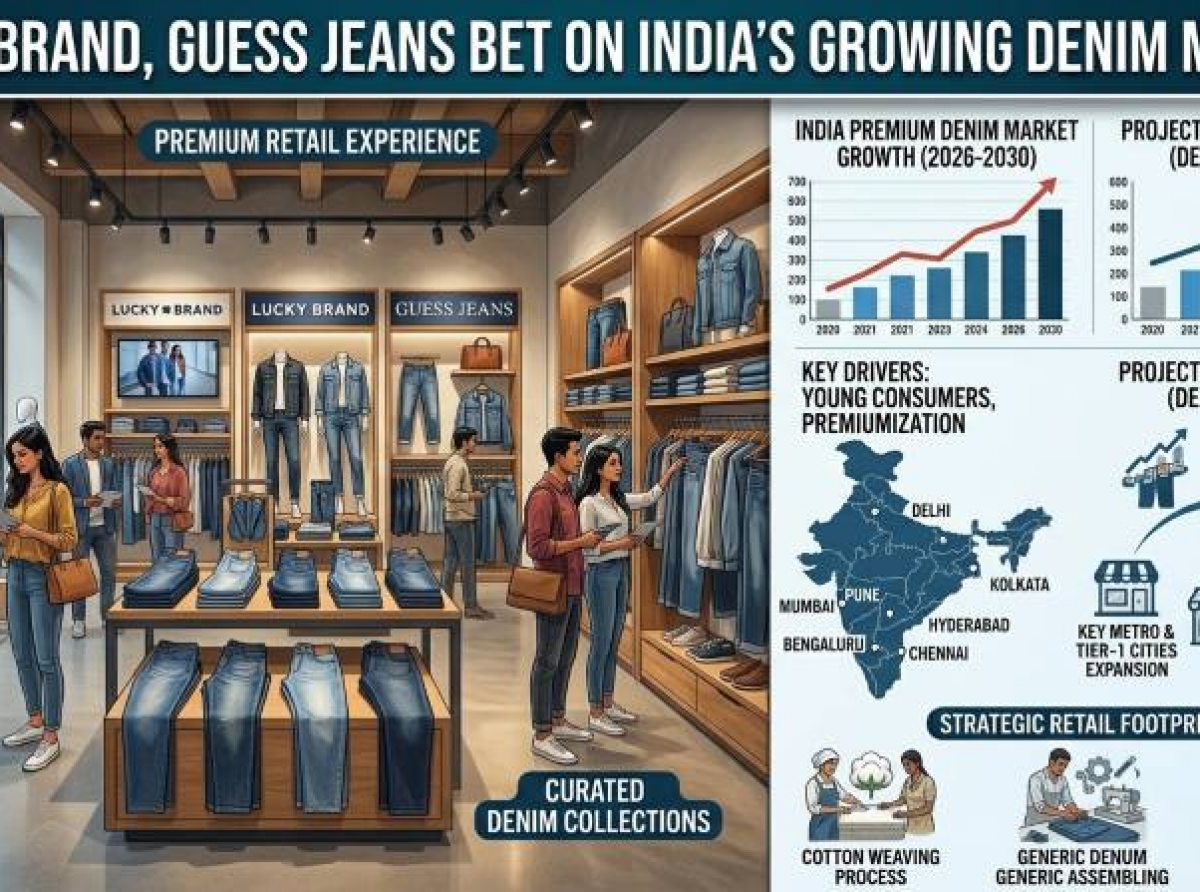
American denim brands Lucky Brand and Guess Jeans are entering India as international fashion companies look to capture growing demand for premium casualwear. Their simultaneous launches underline the rising appeal of India's organised denim market, where rising disposable incomes, branded consumption and premiumisation are creating opportunities for global labels.
Authentic Brands Group-owned Lucky Brand has entered through an exclusive omnichannel distribution partnership with Confluxe Retail. Guess Jeans, the standalone denim concept developed by Nicolai Marciano, is building its retail presence through Shoppers Stop while extending digital distribution across Tata CLiQ, Myntra, AJIO, Nykaa Fashion and its own platform.
The timing is significant. India's textile and apparel market is valued at approximately $147 billion, while the domestic denim market is estimated at $9.15 billion. The segment is projected to reach $12.27 billion, growing at an annual rate of 8-9 per cent. For international brands facing slower discretionary consumption and inventory pressures in mature Western markets, India offers a longer-term growth opportunity. However, converting brand recognition into profitable scale will depend on pricing, localisation and distribution economics.
Licensing limits entry risks
Rather than investing heavily in company-owned stores and infrastructure, international brands are relying on Indian partners to manage market entry, distribution and inventory. Lucky Brand's partnership with Bengaluru-based Confluxe Retail follows this model. Led by former Myntra and AJIO executive Rajesh Narkar and H&M India veteran Louis Coucke, the company is backed by Wavemaker Partners and Kriscore Capital.
Its strategy combines global brand positioning with local merchandising. Instead of importing Western fits and assortments without modification, Confluxe has adapted sizing and silhouettes for Indian consumers. Its assortment includes mid-rise vintage and relaxed baggy styles, with lifestyle tops starting at Rs 1,499 and core denim priced at Rs 3,999. The pricing places Lucky Brand within reach of aspirational consumers while positioning it above mass-market denim labels.
The emphasis on fit and local relevance is critical in a market where consumers increasingly expect international brand credentials without compromising on comfort, sizing or value. "India's premium consumer is no longer satisfied with label prestige alone; they demand precise tailoring suited to domestic climates and proportions," says Rajesh Narkar, CEO of Confluxe Retail.
For Guess Jeans, the partnership with Shoppers Stop offers a different route to scale. Its established department store network provides access to premium shopping destinations and an existing affluent customer base, reducing the time and capital required to build an independent retail network.
The approach reflects a wider industry trend. Arvind Fashions has developed a multi-brand portfolio around Tommy Hilfiger, Calvin Klein and U.S. Polo Assn., while Reliance Retail has expanded its international brand portfolio through licensing and distribution partnerships, including Gap and Superdry.
Market potential remains uneven
India's denim opportunity is substantial, but consumption patterns reveal considerable room for expansion as well as structural limitations.
Table: Indicators of the Indian textile & denim market
|
Economic indicator |
Value |
Global benchmark |
|
Direct industry revenue |
$614 bn |
210 consumer markets; 62 manufacturing hubs |
|
GDP contribution |
$675 bn |
0.6% of global output |
|
Global employment supported |
28 mn |
10.5 million direct jobs |
|
Tax contribution |
$230 bn |
$120 billion direct; $110 billion indirect |
|
Average import tariff |
14.10% |
Against 5.2% for traded goods and 2% for pharmaceuticals |
The low per capita consumption highlights the category's long-term potential. However, growth will require expanding denim adoption and purchase frequency rather than relying solely on India's large consumer base.
The gender imbalance is another opportunity. Men's denim accounts for an estimated 86-89 per cent of market value, while women's denim contributes only 11-14 per cent. This leaves considerable headroom for brands capable of developing products that appeal to women beyond conventional jeans fits.
Competition from ethnic and fusion wear, however, remains a constraint. Growing women's participation in the category will require stronger product development, fit innovation and lifestyle positioning.
Incumbents raise the bar
New entrants are not entering an uncontested market. Levi Strauss & Co., Pepe Jeans and Spykar have established distribution networks and strong consumer recognition across metropolitan and smaller urban markets.
Levi's, in particular, has built a strong position through exclusive brand outlets, department store distribution, local marketing and a broad price architecture. Its ability to serve both entry-level premium consumers and higher-spending buyers gives it an established advantage.
Arvind Fashions' financial performance also demonstrates the commercial potential of international labels in India. The company reported quarterly revenue of Rs 1,558.83 crore, while net profit increased 19.4 per cent year on year to Rs 67.6 crore. EBITDA grew 15.5 per cent. Tommy Hilfiger and Calvin Klein have benefited from premium positioning and demand in urban markets, where consumers are willing to pay higher prices for established labels, differentiated designs and perceived quality.
Pepe Jeans, meanwhile, has expanded beyond major metros into secondary consumption markets, showcasing the importance of geographic reach in building denim volumes. For Lucky Brand and Guess Jeans, the challenge will be to establish a distinct identity rather than compete exclusively on international branding.
Costs could test margins
India's premium denim market also carries significant operating challenges. Prime mall rentals in Mumbai, Bengaluru and Delhi-NCR can range between Rs 400 and Rs 650 per sq. ft., putting pressure on store-level profits. Import duties on foreign-manufactured garments and technical denim blends add to landed costs, potentially forcing brands to absorb lower margins or increase retail prices.
The Rs 3,500-8,000 price segment is particularly competitive. Established players already have strong consumer recall, distribution reach and access to franchise networks. New labels will need to justify their premiums through product differentiation, design and consistent quality. Expanding beyond denim into knitwear, jackets, accessories and other casualwear categories could improve average transaction values and reduce dependence on a single product category.
EASITEX
Beyond the brand name
Lucky Brand's India strategy draws on its Los Angeles heritage and vintage Americana positioning. Established in 1990, the brand is known for its distressed denim, relaxed silhouettes and artisanal detailing. Under Authentic Brands Group, it operates through a global licensing and brand-management model across apparel, footwear and accessories.
Its Indian expansion, alongside Guess Jeans, reflects confidence in the country's premiumisation cycle. But the opportunity is not simply about importing American denim brands into a growing market. The next phase of competition will be determined by how effectively global labels adapt their products, pricing and distribution to Indian consumption patterns. Brand heritage may open the door; local relevance, repeat purchases and profitable retail economics will determine whether they can stay.











 Get in Touch!

