
Festive dependency fades as fashion retailers chase 52-week demand
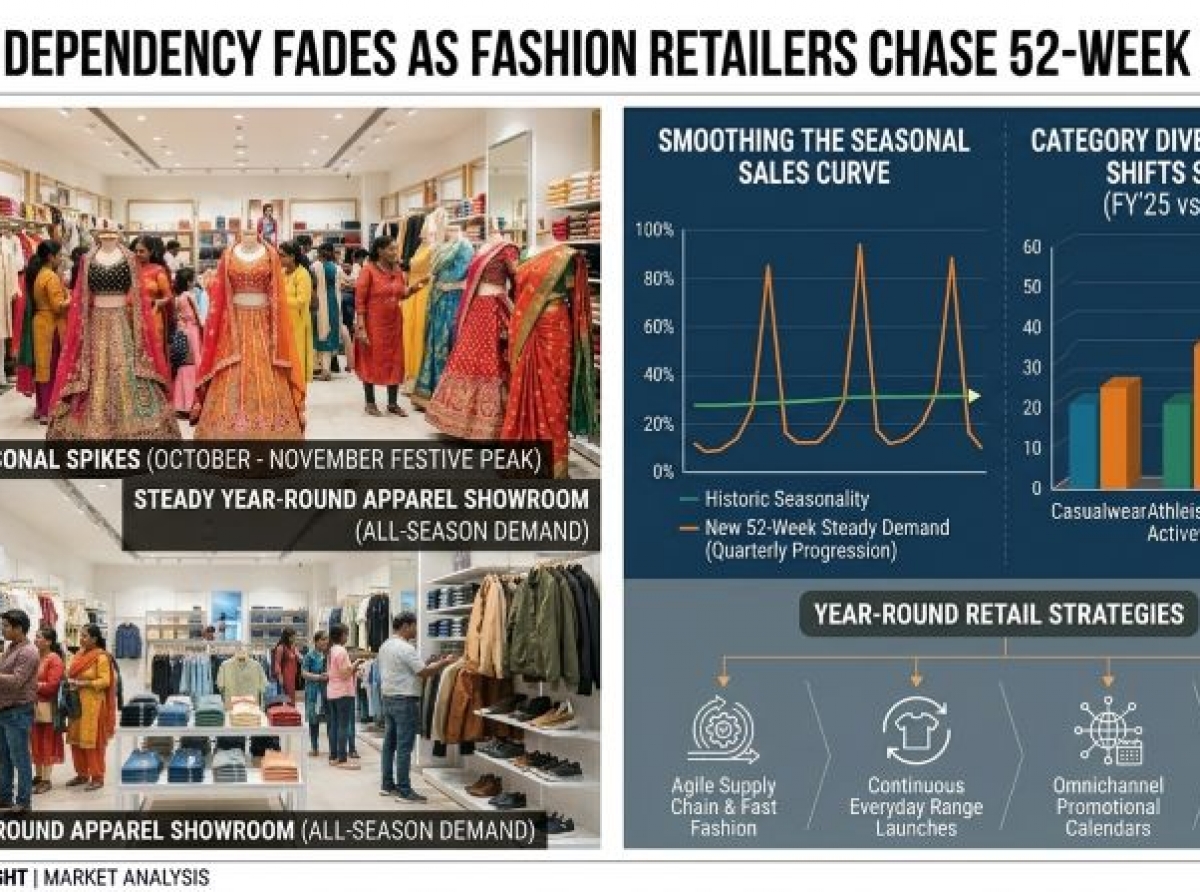
India’s organised fashion retail sector is reworking its business model to reduce dependence on the traditional festive quarter. For years, the 90-day period covering Onam, Durga Puja and Diwali contributed an estimated 35-40 per cent of annual sales for several retailers. But rising inventory costs, aggressive discounting and unpredictable consumer spending are making this concentration increasingly difficult to sustain.
Retailers are shifting towards a 52-week demand model, prioritising faster inventory replenishment, smaller merchandise drops and products designed for everyday consumption. Workwear, smart casuals, resort wear, athleisure and versatile occasion wear are gaining importance as companies seek more consistent store traffic and better full-price realisations. The change is not about diminishing the festive season's commercial importance. It is about reducing the risks of depending on a narrow sales window to deliver annual profitability.
Cost of seasonal dependence
Festive-led retailing creates some pressure on working capital. Large advance purchases, inventory accumulation and high promotional spending can erode margins when consumer demand falls short of expectations.
Online retailers face additional pressures. Return rates can exceed 30 per cent during high-volume campaigns, adding reverse logistics costs and complicating inventory management. Heavy marketplace discounting, price matching and promotional subsidies can compress garment gross margins by an estimated 300-500 basis points. Unsold festive inventory also creates a cascading problem. Post-Diwali markdowns can overlap with subsequent winter collections, forcing retailers to discount merchandise before its full-price selling window has played out.
As Kumar Rajagopalan, Chief Executive Officer , Retailers Association of India (RAI) explains, the limitations of relying heavily on third-quarter sales. With high rentals, employee costs and other fixed operating expenses, retailers need more predictable revenue across the year. The response is a shift from traditional seasonal buying towards six-to-eight-week merchandise drops, shorter manufacturing-to-store timelines and more disciplined replenishment.
Private labels drive change
The operating models of India's major fashion retailers show how inventory control and product ownership are becoming central to this transition.
Table: Apparel retailers operational & supply chain comparison
|
Retailer |
Operating strategy |
Private label contribution |
Supply chain approach |
|
Trent (Westside and Zudio) |
Proprietary labels, frequent merchandise drops, and limited discounting |
Over 99% |
12-15 days from design to retail rack |
|
Aditya Birla Fashion and Retail (ABFRL) |
Lifestyle brands, youth fashion, designer partnerships, and luxury |
Around 60% in value formats |
Multi-tier vendor network and seasonal updates |
|
Raymond Lifestyle |
Formalwear, ceremonial clothing, tailoring, and casual smartwear |
Strong proprietary portfolio |
Mills-to-retail integration and seasonal tailoring |
|
Reliance Retail |
Value fashion, fast fashion, and premium digital distribution |
Around 60% of apparel sales |
Large-scale sourcing and multi-format distribution |
Private labels give retailers greater control over product development, sourcing, pricing and inventory decisions. They also reduce dependence on external brands and allow merchandise to be calibrated to local demand.
Trent's Westside and Zudio showcase this model through high private-label penetration, rapid product development and a relatively disciplined discounting strategy. The reported 12-15-day design-to-rack cycle allows the company to respond quickly to changing consumer preferences rather than committing excessive inventory months in advance. For retailers operating across multiple price points, this speed is increasingly important to protecting merchandise productivity.
Designers move beyond bridal
The shift towards year-round consumption is also changing India's designer and premium fashion businesses. So far, most designer labels depended heavily on bridal lehengas, wedding sherwanis and elaborate occasion wear. These categories generate high transaction values but are vulnerable to wedding-calendar fluctuations and concentrated seasonal demand.
Designers are therefore expanding into ready-to-wear, lightweight fusion clothing, contemporary ethnic separates and everyday luxury. ABFRL has pursued this strategy through its portfolio of lifestyle and designer partnerships, including Tasva, House of Masaba and Sabyasachi. The objective is to build businesses that extend beyond high-value ceremonial purchases and establish more frequent consumer engagement.
Tarun Tahiliani's expansion into accessible ready-to-wear and contemporary Indian clothing reflects a similar commercial direction. While couture and bridal remain important to designer economics, functional tailoring, breathable fabrics and versatile separates offer opportunities to reach consumers outside wedding and festive periods. For these businesses, diversification also helps maintain manufacturing utilisation and distribution networks during traditionally weaker months.
Tier-II cities expand the demand base
Geographic diversification is reinforcing the move towards year-round sales. The expansion of corporate offices, professional services and digital commerce across Tier-II, III cities is creating demand for workwear, western wear, smart casuals and functional athleisure.
Value retailers like V-Mart and Reliance Trends are targeting these markets with accessible price points and wider merchandise assortments. Style Baazar is also positioned to benefit from the expansion of organised value fashion in smaller urban centres. Unlike traditional festive purchases, everyday wardrobe replenishment is driven by recurring requirements. This gives retailers opportunities to build repeat transactions rather than depend on a handful of high-volume shopping occasions.
However, regional differences in income, climate, consumption patterns and fashion preferences require more localised merchandise planning. A uniform national assortment may not deliver the same inventory productivity across smaller markets.
Trent is an example of of how operating discipline can reduce seasonal dependence. Established in 1998 under the Tata Group, the company operates Westside, Zudio and Star Bazaar. Its fashion business is built around proprietary merchandise, accessible pricing and frequent inventory refreshes.
With over 99 per cent of its merchandise under private labels, Trent has greater control over sourcing, design and pricing. Its reported 12-15-day design-to-rack cycle supports faster responses to demand and reduces the need for large seasonal inventory commitments. The model also encourages recurring store visits, as consumers encounter new merchandise beyond conventional festive and end-of-season launches.
Its approach contrasts with businesses that rely more heavily on external brands, longer buying cycles and promotional sales to clear accumulated stock. The broader lesson is that inventory velocity, rather than festive sales alone, is becoming a more important determinant of retail performance.
Profits take centre stage
The festive quarter will remain a significant revenue driver for Indian fashion retailers. Weddings, festivals and holiday shopping continue to generate concentrated demand, particularly in ethnic wear, occasion clothing and premium categories.
But the sector is changing with high rentals, inventory financing costs, discount-led competition and volatile discretionary spending leaving little room for inefficient merchandise planning. Retailers are competing on their ability to capture everyday wardrobe spending through faster replenishment, differentiated private labels and wider geographic reach.
The next phase of organised fashion retail growth will therefore depend less on how much a retailer sells during a single quarter and more on how efficiently it converts inventory into cash throughout the year.










 Get in Touch!

