
Nykaa fashion bets on premium labels and repeat buyers to drive profits
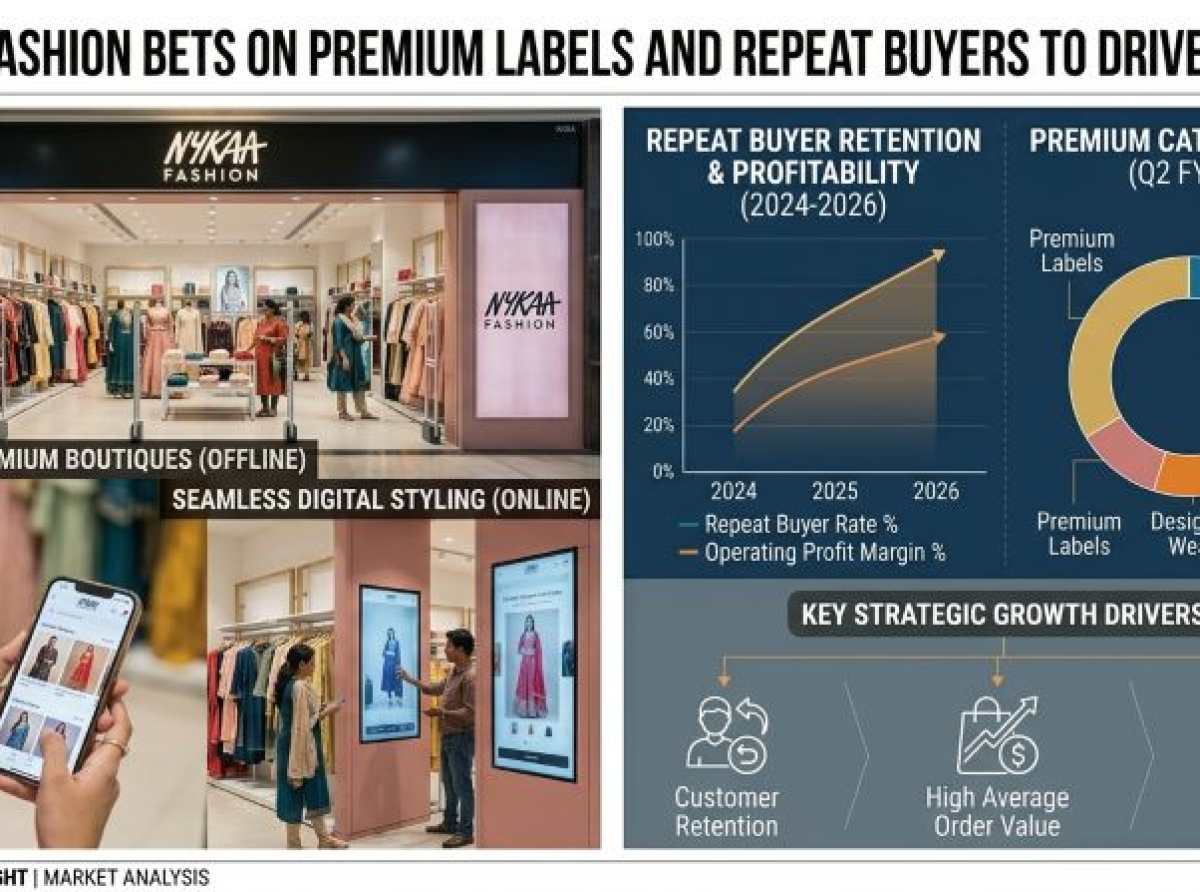
Nykaa Fashion is shifting its growth strategy from customer acquisition-led expansion to margin-focused operations, targeting high-single-digit EBITDA margins by FY30 and over 10 per cent in the steady state. The strategy rests on premium brands, exclusive labels, higher repeat purchases and lower customer acquisition costs (CAC), as the fashion business consolidates its operating turnaround.
The roadmap, outlined by Nykaa Fashion CEO Abhijeet Dabas during the company's recent earnings interaction, signals a move away from volume-led growth and discount-driven sales towards stronger full-price realisation and improved unit economics. The fashion vertical reported its third consecutive quarter of operating break-even in Q2 FY27, with EBITDA of Rs 1 crore against a loss of Rs 12 crore in the year-ago period. Net sales value (NSV) grew 47 per cent year-on-year to Rs 509 crore, while revenue increased 43 per cent to Rs 287.24 crore; first-half NSV rose 50 per cent to Rs 960 crore.
The improvement came alongside stronger consolidated performance at parent FSN E-Commerce Ventures. Revenue from operations increased 28 per cent to Rs 3,006 crore in Q2 FY27, while EBITDA rose 65 per cent to Rs 263 crore. Net profit increased 207 per cent to Rs 101 crore from Rs 33 crore a year ago.
Table: Nykaa Fashion’s Q2FY27 results
|
Metric (consolidated Q2 FY27) |
Q2 FY26 |
Q2 FY27 |
YoY growth (%) |
|
Consolidated Revenue |
Rs 2,346 cr |
Rs 3,006 cr |
28% |
|
Consolidated EBITDA |
Rs 159 cr |
Rs 263 cr |
65% |
|
Consolidated PAT |
Rs 33 cr |
Rs 101 cr |
207% |
|
Fashion Net Sales Value (NSV) |
Rs 346 cr |
Rs 509 cr |
47% |
|
Fashion Vertical EBITDA |
-Rs 12 cr |
Rs 1 cr (Break-even) |
Turned Positive |
Cutting acquisition costs
Lower customer acquisition costs are central to Nykaa Fashion's profits ambitions. The company has reduced unit CAC by approximately 30 per cent year-on-year, leveraging the parent platform's beauty customer base of more than 35 million active transacting consumers.
Instead of relying heavily on expensive digital advertising to acquire new shoppers, the fashion business is using existing beauty customer relationships to cross-sell apparel, footwear and accessories. Repeat shoppers accounted for the majority of gross platform GMV during the quarter, improving marketing efficiency. Average order value (AOV) also increased 5 per cent to Rs 2,149, supported by demand for occasion wear, workwear and premium lifestyle products.
Higher basket values improve revenue per transaction and help absorb fulfilment, packaging and logistics costs. The emphasis is increasingly on customer lifetime value rather than the cost of acquiring individual transactions.
Betting on owned brands
Brand ownership is another pillar of the margin strategy. Nykaa's House of Nykaa portfolio has achieved an annualised GMV run-rate exceeding Rs 4,000 crore and NSV of more than Rs 2,300 crore, growing 36 per cent. Dot & Key has reached an annualised NSV run-rate of Rs 1,300 crore, while Kay Beauty and Nykaa Cosmetics have achieved run-rates of Rs 350 crore and Rs 300 crore, respectively.
The economics of proprietary brands are materially different from third-party marketplace distribution. While marketplace commissions typically range between 18 per cent and 24 per cent, owned brands offer greater control over product pricing, distribution and gross margins, with potential realisations of 55 per cent to 65 per cent.
The company is looking to extend this model through acquisitions and portfolio expansion. Its board approved the acquisition of an 82 per cent stake in beauty and personal care brand Simply Nam for Rs 33 crore. The brand reported net revenue of Rs 17 crore in FY26. Integrating acquired businesses into existing warehousing, distribution and retail infrastructure can also limit incremental overheads while expanding the group's brand portfolio.
Premiumisation as a hedge
Nykaa Fashion's premiumisation strategy also addresses a persistent weakness in online apparel retail: product returns and reverse logistics. Returns in mass-market fashion commerce can range between 25 per cent and 35 per cent, driven by sizing issues, impulse purchases and cash-on-delivery orders. Reverse freight, inventory refurbishment and unsold returned merchandise put pressure on operating margins.
Premium and curated fashion categories generally experience lower return rates, estimated at 15 per cent to 18 per cent in segments such as designer wear, formal tailoring and occasion wear. A greater share of prepaid transactions among premium customers can further reduce return-to-origin costs. The expansion of Nykaa Fashion LUXE, alongside international brands such as Birkenstock, Superdry and COS, is intended to strengthen its presence among higher-spending urban consumers.
Competition tests the roadmap
The margin targets, however, come against an intensely competitive digital fashion market. Myntra, Reliance Retail's Ajio and Tata CliQ Luxury have significant financial resources and established customer bases. Fast-fashion players such as NEWME are also competing aggressively for younger consumers through rapid product launches and trend-led merchandise.
Nykaa Fashion must therefore balance cost discipline with customer acquisition and brand-building investments. Overdependence on cross-selling to existing beauty customers could limit expansion if new shopper acquisition slows, particularly beyond metropolitan markets.
India's online fashion retail market is projected to grow at a 21.1 per cent CAGR, adding over $56 billion between 2026 and 2030, as per Technavio estimates. The opportunity is substantial, but sustained profits will depend on how effectively platforms manage discounts, fulfilment costs and returns.
For Nykaa Fashion, the immediate priority is to convert its operating break-even into consistent profitability without sacrificing growth. Its FY30 ambition will ultimately depend on whether premium labels, repeat purchases and shared group infrastructure can deliver durable margin expansion in a market where customer acquisition remains expensive.











 Get in Touch!

