
The 2026 Offline Retail Format Disruption: From ‘Points of Sale’ to ‘Points of Experience’
30 December 2025, Mumbai
As the industry navigates the final quarter of the current fiscal year, this feature serves as the cornerstone of our "Wrap Up 2025, Outlook 2026" series.
We look back at a year where the Indian apparel sector moved beyond post-pandemic recovery into a phase of aggressive structural transformation.
The 2025 cycle has been a period of reckoning for brand-to-retail connectivity, characterized by a decisive pivot toward large-scale experiential formats and the high-velocity expansion of value-driven models into the heartland.
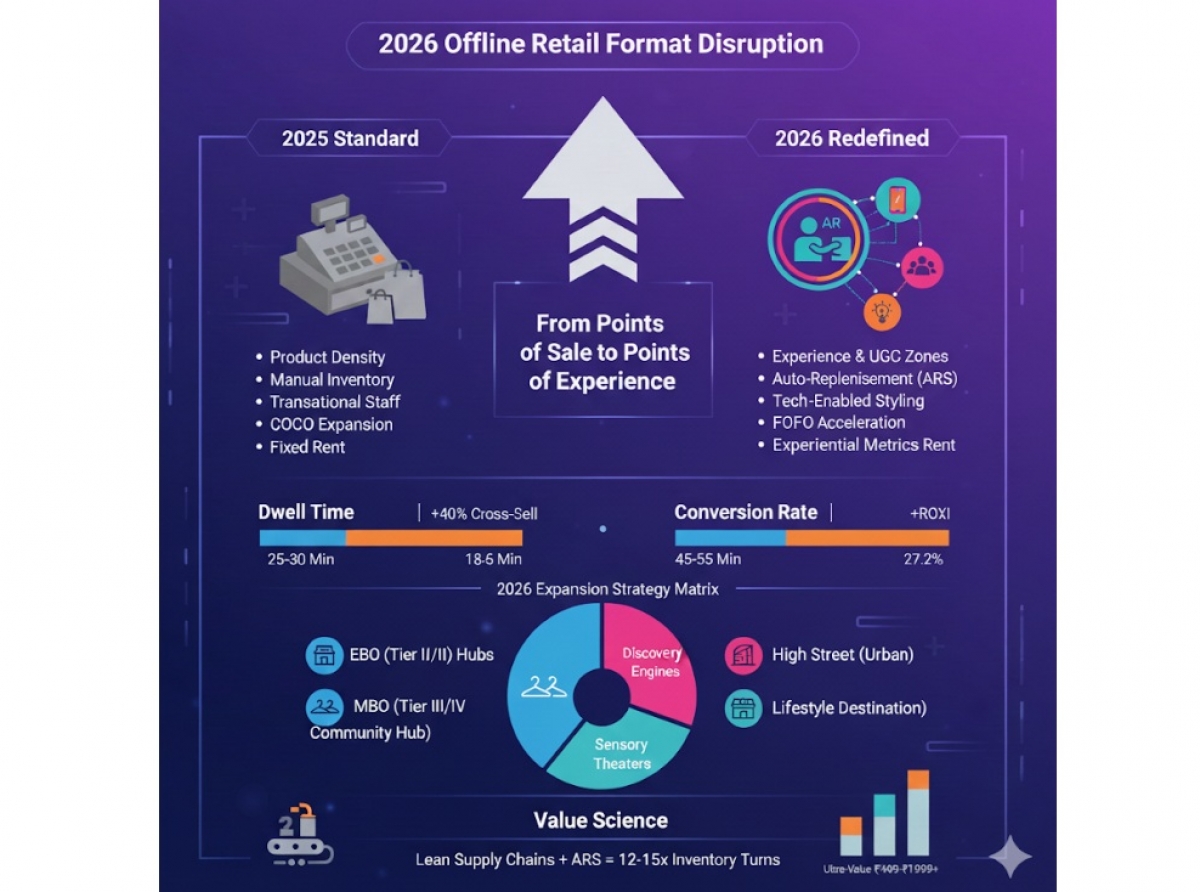
As we project into 2026, the industry is preparing for a cycle where the very definition of a "store" is undergoing a radical redefining. The bridge between brand and consumer is no longer just about proximity; it is about the intelligence of the physical format.
Read our latest issue
Benchmarking the Shift: Operational excellence in 2026
To understand the depth of this transformation, we must look at the operational metrics that are redefining the bottom line.
The transition from 2025 to 2026 is not merely aesthetic; it is a fundamental overhaul of how a store functions as a commercial unit.
Table 1: Comparison of Offline Operational Benchmarks (2025 vs. 2026)
|
Operational Pillar |
2025 Standard Practice |
2026 Redefined Strategy |
B2B Impact |
|
Inventory Flow |
Manual/Push-based |
Auto-Replenishment (ARS) |
30% Reduction in OOS (Out of Stock) |
|
Store Layout |
Product Density Focus |
Experience & UGC Zones |
1.8x Increase in Brand Recall |
|
Expansion Model |
COCO (Company Owned) |
FOFO (Franchise Owned) |
Accelerated ROCE (Return on Capital) |
|
Staff Training |
Transactional |
Tech-Enabled Styling |
15% Higher Average Transaction Value |
The Anchor Evolution: From inventory hubs to experience centers
In 2025, the offline landscape witnessed a "Bigger, Better, Bolder" movement. Malls transformed as compact 2,000-square-foot boutiques were consolidated into massive 10,000-square-foot anchor stores.
This was not a simple real estate land grab; it was a strategic transformation to make physical stores indispensable. Large Format Retail (LFR) successfully transitioned from being inventory-heavy anchors to becoming "Experience Hubs."
The 2026 outlook intensifies this into the "Sensory Flagship." The upcoming year marks the end of the passive window display.
In its place, phygital integration—AR mirrors that overlay seasonal collections and smart trial rooms that suggest the perfect accessory for a selected blazer—is becoming the baseline expectation for the premium consumer.
This retail format disruption is forcing a shift in mall economics: forward-thinking developers are now restructuring rent models to favor "Experiential Metrics" over traditional sales-per-square-foot.
Table 1: The "Dwell-to-Dollar" Shift in LFR (2025 vs. 2026 Projected)
|
Performance Metric |
2025 Benchmark (Standard LFR) |
2026 Outlook (Sensory Hub) |
Strategic Outcome |
|
Average Dwell Time |
25-30 Minutes |
45-55 Minutes |
40% higher cross-sell probability |
|
Conversion Rate |
18.50% |
27.20% |
Optimized staff-to-customer ROI |
|
UGC Hits per Sq. Ft. |
Minimal |
4-6 Posts/Day |
Organic, zero-cost brand advocacy |
|
Rent Structure |
Fixed + Revenue Share |
Revenue Share + Footfall Quality |
Alignment of Developer-Brand goals |
The Franchise War: Reclaiming Bharat via FOFO efficiency
While metros experimented with high-tech flagships, 2025 saw a territorial gold rush in Tier II and III cities. Exclusive Brand Outlets (EBOs) surged by 30% in these regions as brands sought territory protection. However, the 2026 outlook suggests an "MBO Renaissance." As the cost of maintaining stand-alone stores rises, Multi-Brand Outlets (MBOs) are regaining status as "discovery engines."
The operational vehicle of choice for 2026 expansion is the FOFO (Franchise Owned, Franchise Operated) model. By offloading operational friction to local partners who understand regional nuances, national brands are scaling at a velocity previously unseen. This strategy is redefining the "Bharat" expansion playbook: use MBOs for wide-net reach and EBOs for "Brand Advocacy" and premium storytelling.
Table 2: Offline Expansion Strategy Matrix for 2026
|
Format |
2025 Status |
2026 Strategic Mandate |
Target Geography |
|
EBO (Exclusive) |
Brand Visibility Points |
Hyper-local Community Hubs |
Tier I & II High Streets |
|
MBO (Multi-Brand) |
Distribution Nodes |
Discovery & Recruitment Engines |
Tier III & IV Catchments |
|
LFR (Anchor) |
Stock-heavy Warehouses |
Sensory "Theaters" |
Grade A+ Malls |
|
High Street |
Convenience-led |
Lifestyle Destination |
Established Urban Corridors |
The Value Science: Efficiency redefining the discount format
Perhaps the most disruptive force of 2025 was the democratization of trend-led fashion through the "Value Segment."
The explosive growth of formats like Zudio, Yousta, and Style-Up has forced a complete redefining of the backend. If 2025 was about the front-end price, 2026 will be about the back-end margin.
The "Value Science" of 2026 relies on "Lean Supply Chains" and "Auto-Replenishment Systems" (ARS).
The winners will not be those who can design a ₹199 t-shirt, but those whose algorithms ensure that the t-shirt is never out of stock while maintaining zero dead inventory.
Data from 2025 indicates that top-tier value retailers are achieving 12-15 inventory turns a year, nearly double the industry average of 6-7 turns.
Table 3: Value Retail Productivity - 2025 Benchmarks
|
Segment |
Sales per Sq. Ft. (Monthly) |
Inventory Turnover |
Core Price Band |
|
Ultra-Value (Zudio/V2) |
₹1,000 - ₹1,200 |
12x - 15x |
₹199 - ₹999 |
|
Mid-Market Value (Max/Pantaloons) |
₹750 - ₹950 |
7x - 9x |
₹499 - ₹1,499 |
|
Premium Lifestyle |
₹1,200 - ₹1,800 |
4x - 6x |
₹1,999+ |
Leadership Outlook: C-Suite and strategic redefinition
For the leadership at the helm of India’s fashion houses, the mantra for 2026 is "Agility over Legacy." The C-suite is no longer looking at five-year plans; they are looking at weekly store-level performance and catchment dynamics.
"The greatest risk in 2026 is being too big to move," says a leading CEO of a major retail conglomerate. "We are seeing a shift where our physical stores must act as media channels first and fulfillment centers second.
This retail format disruption is not a threat; it's an opportunity to own the consumer's time. Our 2026 strategy for redefining the store experience is built on 'Micro-Market Intelligence'—knowing exactly what a consumer in Indore wants versus a consumer in Lucknow, and having it on the rack before they even ask."
Leadership is also prioritizing "Asset-Light" expansion through the FOFO model, aiming for a 20% improvement in Return on Capital Employed (ROCE) by transferring the real estate risk to regional partners while maintaining centralized control over merchandising and technology.
Editor’s Conclusion: The year of the "Intelligent Node"
As we conclude this segment of our 2025 analysis, it is clear that the "New Normal" in offline retail is anything but static.
The apparel industry has successfully navigated the post-pandemic surge and subsequent inflationary pressures. Looking toward 2026, the theme is undoubtedly "Structural Transformation."
The retail format disruption we are witnessing is not the death of the store, but its reincarnation as an "Intelligent Node."
Whether it is a 15,000-square-foot flagship in a Mumbai mall or an 8,000-square-foot value store in a Tier III high street, every square foot must now justify its existence through data or delight.
The brands that thrive will be those that treat their physical footprint as a high-performance engine, not just a static billboard.
The wardrobe of 2026 will be chosen in an environment where the boundary between the brand and the buyer is seamlessly erased by superior design and operational excellence.
Disruption...Disruption...Disruption!










 Get in Touch!
