
Retailers cap apparel price hike to protect footfalls and festive demand
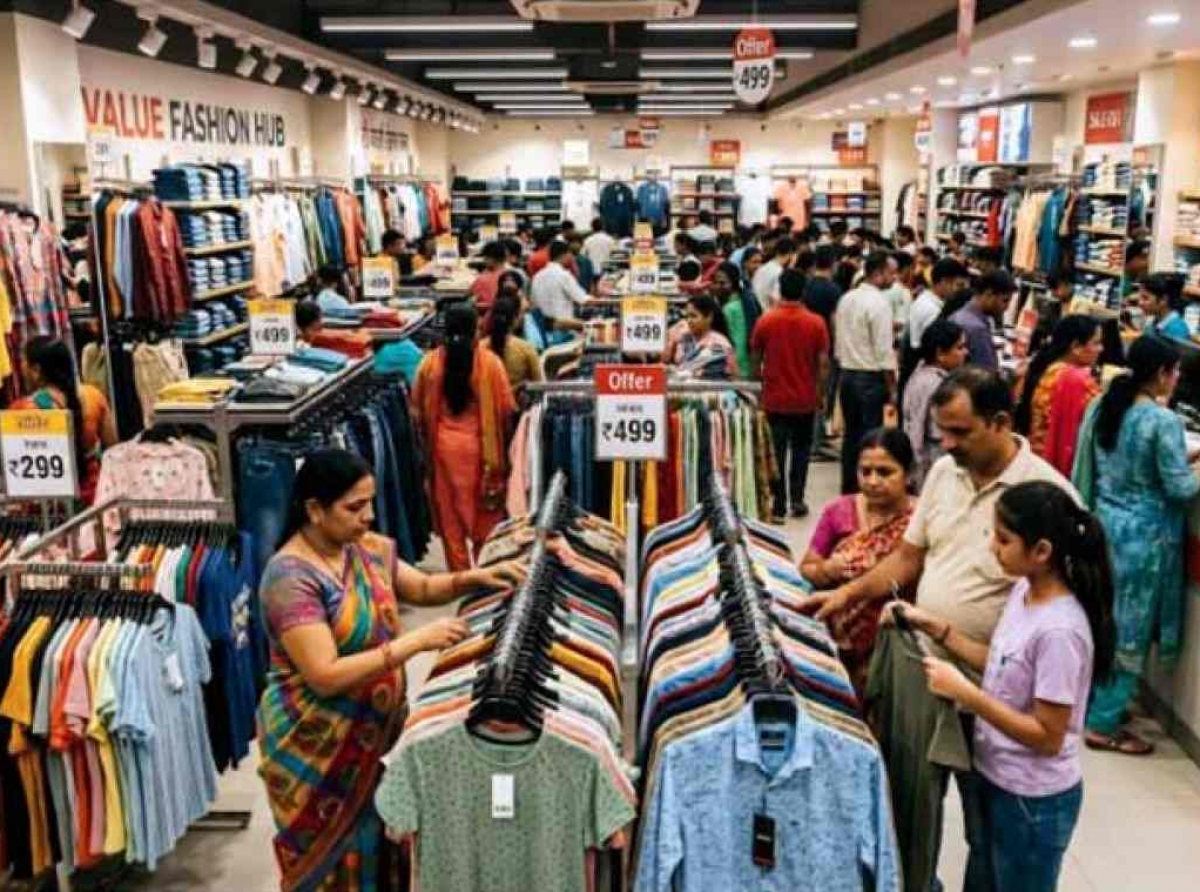
Indian apparel retailers are choosing volume and customer retention over aggressive price hikes as cotton, yarn, synthetic fibre and freight costs remain volatile. Across value fashion and lifestyle retail, companies are largely restricting ticket-price increases to 2-5 per cent, absorbing part of the cost escalation rather than risking weaker footfalls and smaller baskets.
The strategy reflects a broader reworking of apparel retail business. With consumers remaining sensitive to entry prices, particularly in value formats, retailers are relying on procurement efficiencies, direct sourcing and higher inventory buffers to defend merchandise margins without materially altering shelf prices.
Price discipline takes priority
Clearly, the pricing response across organised apparel retail has been measured. Companies are using modest price revisions, protected opening price points and tighter sourcing controls to manage inflation.
Table: Ticket price adjustments by apparel brands
|
Fashion retailer |
Segment focus |
Pricing strategy & price adjustment |
Top-line revenue growth (Q1) |
Supply chain & sourcing strategy |
|
V2 Retail |
Value Fashion |
4% to 5% calibrated price increase |
+58.4% YoY |
Rapid floor inventory turns, tight batch-sourcing |
|
V-Mart Retail |
Value Fashion- Tier II-IV |
3% to 5% average selling price (ASP) cap |
+23.0% YoY |
Sourcing realignment, opening-tier price protection |
|
Style Bazaar |
Regional Value Fashion |
Low-single-digit upward revision |
+28.7% YoY |
Cluster-based regional mill tie-ups |
|
Vishal Mega Mart |
Value Hypermarket / Apparel |
Absorbing freight; insulated opening price tiers |
+18.7% YoY |
Strategic cost absorption to preserve store footfalls |
|
Trent (Zudio / Westside) |
Fast Fashion / Value to Mid |
Unchanged entry points; scale-driven sourcing |
+19.0% YoY (Standalone) |
15-day inventory refreshes, direct mill contracts |
|
Page Industries |
Innerwear & Athleisure |
2.2% weighted average increase |
Modest volume-led recovery |
Multi-week buffer yarn and fabric safety stocks |
The restraint is particularly significant in value fashion, where even relatively small increases can push products beyond psychological price thresholds. For retailers competing with local and unorganised markets, maintaining accessible entry points remains central to driving conversion.
Margins absorb the inflation
The trade-off is more visible in retail profits. Retailers are accepting near-term gross-margin pressure from raw-material inflation, freight expenses, product-mix changes and promotional activity. Extended End-of-Season-Sales have added another layer of pressure, while higher marketing expenditure has been required to sustain store traffic. Companies such as Arvind Fashions, V2 Retail and V-Mart have passed through a portion of the cost increase, generally in the 4-5 per cent range. Meanwhile, mid-to-premium players including Aditya Birla Fashion and Retail and Page Industries have leaned more on internal cost absorption.
The strategy indicates that retailers are treating pricing as a demand-management tool rather than simply a margin-recovery mechanism. A full pass-through may protect gross margin per unit but could simultaneously reduce volumes, footfalls and repeat purchases.
Inventory becomes the new buffer
The response to supply-chain uncertainty is also changing working-capital priorities. Rather than depending exclusively on lean, just-in-time inventories, apparel companies are carrying additional yarn, fabric and finished-goods buffers.
Companies such as Go Fashion and Page Industries have increased safety stocks of core grey fabric and dyed yarn to reduce exposure to spot-market volatility. The additional financing cost of inventory is being weighed against the potentially larger commercial cost of production interruptions or stockouts. This shift is particularly important when freight disruptions can extend transit times and increase landed costs. The Red Sea-related routing disruptions have kept ocean freight an additional variable for sourcing teams, encouraging retailers to secure supplies earlier and diversify procurement across domestic mills and manufacturing clusters.
Value fashion widens its lead
The strongest performance continues to come from value- formats operating across Tier-II, III, IV markets. Double-digit revenue growth at several retailers points to continued migration from traditional local apparel markets toward organised value retail. Yet the headline revenue numbers need to be read carefully. Store expansion remains a major contributor to topline growth, meaning aggregate revenue growth does not necessarily translate into equivalent same-store productivity.
Fast-fashion chains have recorded mid-single-digit comparable-store growth in some cases, but the difference between network expansion and like-for-like throughput remains a key issue for the sector. Premium occasionwear and formalwear have also faced softer demand, partly reflecting the reduced number of auspicious wedding dates and the timing of the 30-day Adhik Maas period.
Zudio's velocity advantage
Trent's Zudio provides perhaps the clearest example of how retail operating architecture can compensate for price rigidity. With over 960 exclusive stores, Zudio has retained its opening-to-mid ticket structure below Rs 999 even amid input-cost volatility. Instead of relying on significant price increases, the format uses speed, scale and private-label control to protect economics.
Zudio refreshes its collections almost every 15 days, substantially faster than the 45-60-day cycle common to conventional apparel chains. Direct garment-maker relationships and proprietary brands further strengthen control over merchandise costs.
The reported COGS range of 60-65 per cent and store sales density exceeding Rs 16,000 per sq. ft. show the potential operating leverage of a high-velocity model. Faster inventory rotation allows the retailer to recover cash more quickly, creating greater flexibility to absorb temporary raw-material inflation.
Festive demand holds the key
The next test for the sector will come from the festive and wedding calendar. Durga Puja, Navratri and Dussehra have shifted by as much as 19 days deeper into the third quarter, creating a weaker comparison in the preceding period but potentially producing a longer consumption window from October through Diwali and into the winter wedding season.
Retailers are therefore betting that traffic and volumes will compensate for some of the margin sacrificed during the cost-inflation phase. An expected stabilisation in cotton prices as fresh domestic crop arrivals improve availability could further ease pressure into the fourth quarter.
The broader strategy is clear: preserve affordability when consumers are most price-conscious, use procurement and inventory management to contain costs, and rely on festive demand to rebuild operating leverage. For India's apparel retailers, the immediate issue is no longer just about who can raise prices fastest. It is about who can withstand input-cost volatility without breaking the price points that keep shoppers walking through the door.











 Get in Touch!
