
TechnoSport, IIT Delhi join hands to build advanced sports textile capabilities
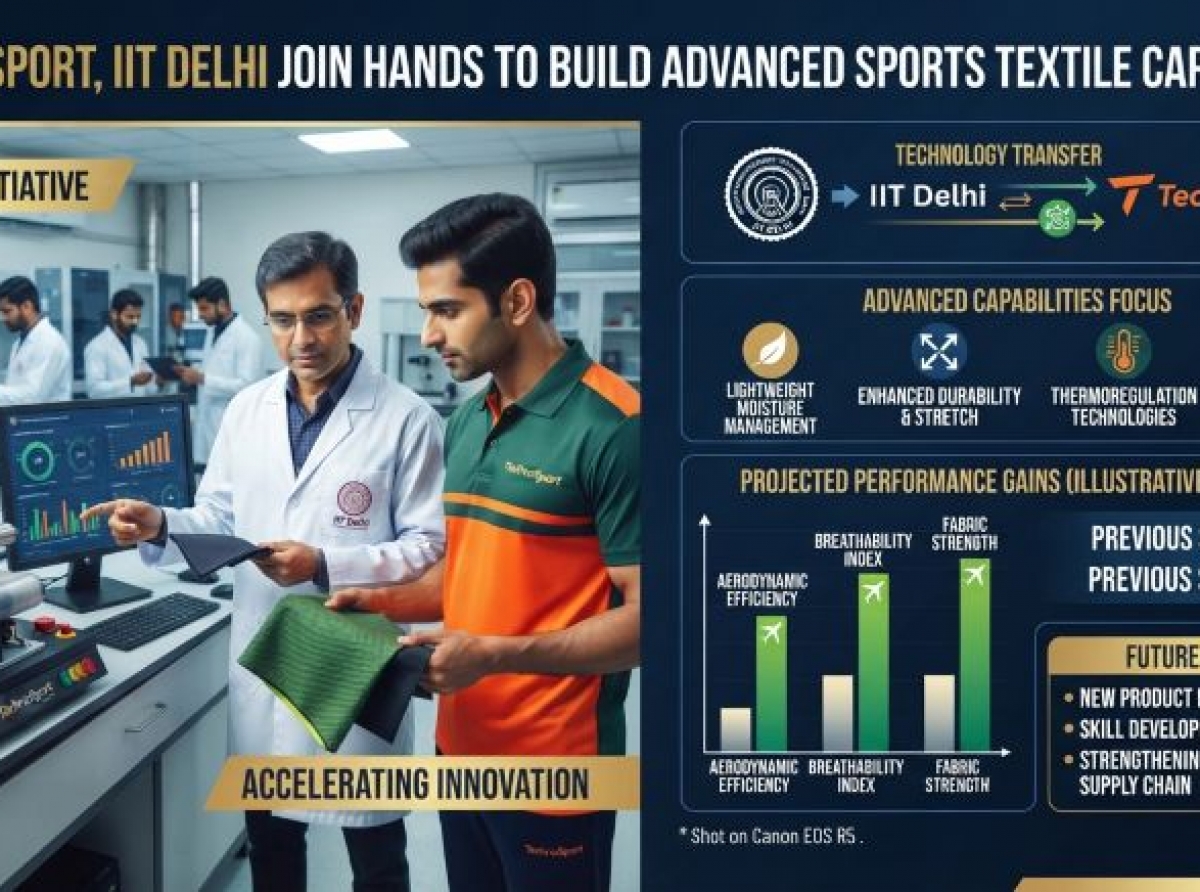
India’s activewear sector is moving beyond low-cost garment manufacturing towards advanced textile engineering. What is driving this shift is T-CREST (TechnoSport Center for Research and Entrepreneurship in Sports Textile), a research, testing and incubation facility established by domestic activewear manufacturer TechnoSport at the Indian Institute of Technology (IIT) Delhi’s Sonipat innovation campus.
Backed by a capital commitment of Rs 4.5 crore over three years, the initiative aims to develop high-performance fabrics and sport-specific apparel that can compete with international brands. While Indian manufacturers have built scale in everyday activewear, technically advanced sportswear remains dominated by global players such as Nike, Adidas, Puma and Under Armour. T-CREST aims to address this gap through research focused on endurance running, badminton, cricket, volleyball and football.
Sunil Jhunjhunwala, Co-founder and MD, TechnoSport explains the objective is to build domestic capabilities in material science, product engineering and technical talent. Manufacturing standard activewear at scale is commercially established in India, but developing competition-grade apparel requires more specialised textile technology.
Bridging research and manufacturing
T-CREST seeks to close the gap between academic research and industrial production. Its R&D programme will focus on moisture management, targeted compression, thermal regulation and antimicrobial finishes. The facility will develop and test advanced textile structures before transferring successful formulations to commercial manufacturing. This could help domestic manufacturers retain greater control over fabric technology, product performance and intellectual property.
TechnoSport will provide the manufacturing backbone. Its integrated facilities in Tirupur, Tamil Nadu, currently produce more than 100,000 garments daily, with annual capacity targeted at 35 million garments.
Daily fabric production of 25 tonnes is planned to increase to 40 tonnes by mid-2026 and 50 tonnes by 2027. This backward integration gives the company a direct route from laboratory development to industrial-scale production.
The initiative also includes an incubation programme for early-stage material science ventures, with seed funding of around Rs 20 lakh per venture. Start-ups will have access to testing facilities, manufacturing infrastructure, supply-chain support and TechnoSport’s distribution network of more than 7,000 retail outlets.
Competing business models
India’s sportswear market has several established players, but their product development and sourcing strategies differ.
Table: Comparative retail and performance
|
Brand |
Sourcing & R&D strategy |
Distribution |
Primary price positioning |
Category focus |
|
TechnoSport (T-CREST) |
In-house backward integration in Tirupur; captive academic R&D at IIT Delhi |
7,000 multi-brand outlets, 50+ EBOs, e-commerce |
Value to mid-market (Rs 499-1,499) |
Performance activewear, technical sport-specific textiles |
|
Decathlon India |
Localized contract manufacturing (85% domestic sourcing); European design labs |
110+ large-format experience superstores |
Entry to mid-market (Rs 299-2,999) |
Multi-sport equipment and functional apparel |
|
Shiv-Naresh |
Traditional contract mills and domestic technical sourcing |
Institutional sports bodies, regional sports retail |
Mid-market competitive (Rs 799-2,499) |
Tracksuits, athletic uniforms, institutional teamwear |
|
Cultsport |
Contract third-party manufacturing; design and digital fitness integrations |
Direct-to-Consumer (D2C), modern marketplaces |
Mid to premium (Rs 899-2,799) |
Running apparel, gym wear, connected fitness gear |
|
Global MNCs (Puma, Nike) |
Global proprietary R&D labs (Dri-FIT, dryCELL); worldwide third-party sourcing |
Exclusive brand stores, premium malls, global e-commerce |
Premium to super-premium (Rs 1,999-7,999+) |
Elite athletic footwear, tournament kits, premium athleisure |
Different routes to scale
The experience of existing players highlights the opportunity for deeper domestic research. Shiv-Naresh built its presence through institutional sports contracts, supplying Indian contingents at major international sporting events and national sports federations. However, its traditional manufacturing model has limited exposure to proprietary fibre technologies and dedicated polymer research.
Decathlon India has strengthened local manufacturing, investing more than Rs 900 crore to increase domestic sourcing to 85 per cent. This has improved sourcing efficiency and cost competitiveness, although specialised product engineering and fabric development continue to rely on its European design infrastructure.
Cultsport, meanwhile, has followed a digital-first model, using fitness communities and online platforms to reach consumers. Its dependence on third-party manufacturers and fabric suppliers, however, limits direct control over textile innovation.
T-CREST combines academic research with captive manufacturing. Its model is designed to develop specialised yarn structures, moisture-wicking channels and performance fabrics while retaining greater control over product development and intellectual property.
A growing performance market
The investment comes as India's sportswear and activewear market grows. Industry estimates place the market at around $11.88 billion in 2026, with annual growth of over 15 per cent till 2034. Growth is being supported by rising participation in community sports, marathon running, fitness activities and government-backed programmes such as Khelo India. Demand is also shifting beyond appearance and branding towards measurable product performance.
Meanwhile, consumers are looking for breathability, stretch recovery, anti-chafing construction, moisture management and odour control. These requirements are raising the importance of fabric engineering in product differentiation.
However, domestic manufacturers face three major constraints: dependence on imported specialty nylon and high-tenacity elastane, lengthy testing and certification cycles, and consumer preference for established international performance brands. Developing competition-grade apparel also requires extensive athlete testing and validation, making commercialisation a longer process than conventional activewear development.
Building domestic textile IP
T-CREST represents a shift in the domestic sportswear industry's approach to competitiveness. Rather than relying primarily on garment assembly, cost advantages and distribution, the focus is moving towards proprietary textile technology. The success of the initiative will depend on its ability to translate lab research into commercially viable fabrics, secure athlete validation and build consumer confidence in Indian-engineered performance products.
If successful, the IIT Delhi-TechnoSport partnership could create a stronger domestic innovation pipeline, reduce dependence on imported technical fabrics and position Indian manufacturers higher in the global sportswear value chain. The larger opportunity lies not just in making more sportswear, but in developing the materials and technology that determine how it performs.











 Get in Touch!

