
Mandatory reporting, Unique Textile ID made prerequisite for central subsidies
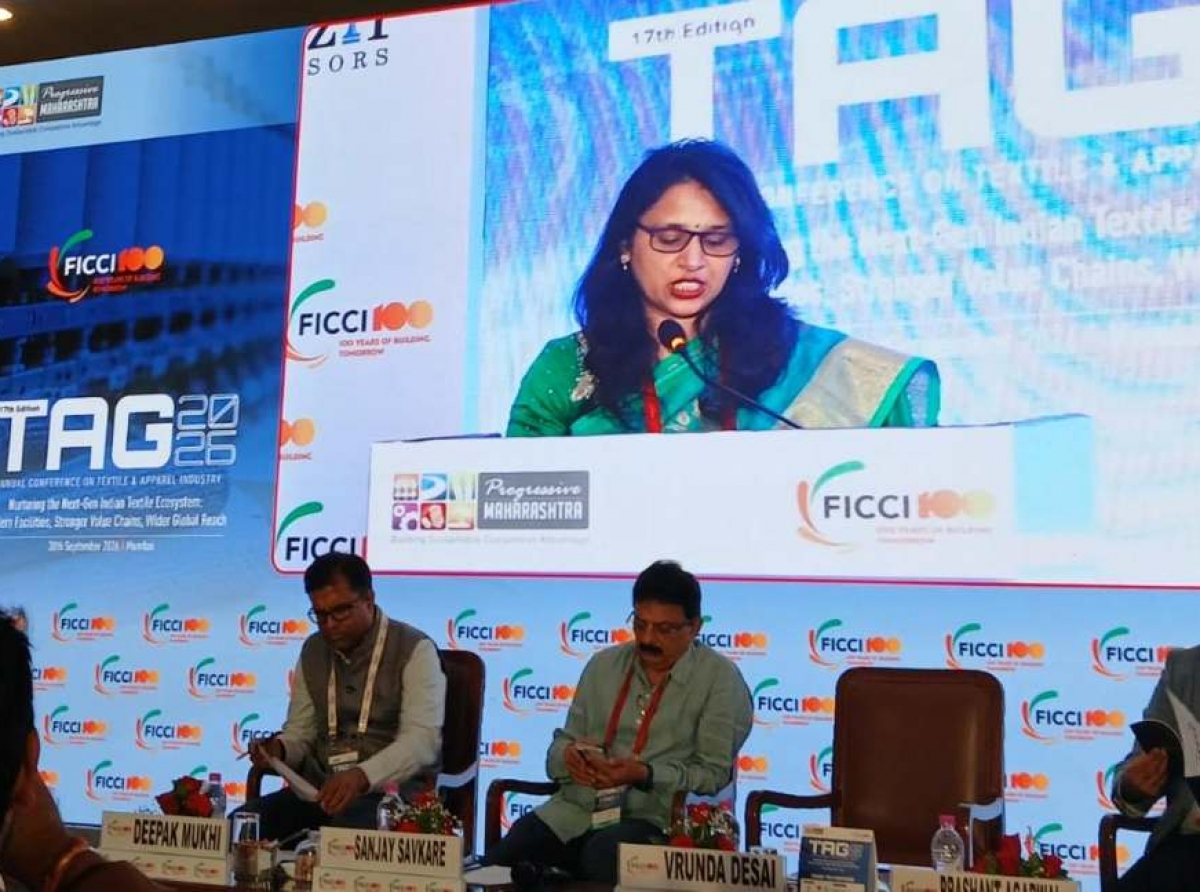
In an enforcement-driven regulatory reform aimed at standardizing data across India’s domestic textile and apparel value chain, Textile Commissioner Vrunda Manohar Desai has declared that all GST-registered textile enterprises and cotton traders must compulsorily register and submit their returns on the revamped Textile Statistical Return System (TSRS) portal. Speaking at the 17th annual FICCI-TAG 2026 conference in Mumbai, Desai warned that units failing to file will face direct penalty proceedings under the Collection of Statistics Act. In a critical move impacting access to institutional capital, she revealed that the Ministry is implementing a Unique Textile Identification Number, confirming that without this mandatory digital identity, textile and garmenting enterprises will be barred from receiving any central government subsidies, incentives, or financial schemes.
Tackling cluster fragmentation with Integrated Mega Parks
Desai highlighted that formal data reporting is vital to shaping central interventions as the domestic textile and apparel market expands from $194 billion toward a targeted $250 billion by 2030. To address the long-standing challenge of structural fragmentation—where spinning, weaving, wet processing, and garmenting operate in geographically dispersed clusters; the government is rolling out seven PM MITRA mega-parks and 100 plug-and-play industrial hubs under the BHAVYA scheme to consolidate operations in single, cost-efficient locations. Underlining the multiplier impact of targeted fiscal assistance, Desai shared official findings from a third-party evaluation of the ATUFS scheme, which revealed that ₹2,776 crore in government subsidies mobilized ₹53,121 crore in capital investments (a 1:19 leverage ratio), modernizing 67 lakh machines, creating 36 lakh jobs, and delivering 15–20% energy and cost efficiencies across domestic factories.
New upgradation schemes and restructured MSME hubs
To extend modernization deep into decentralized clusters, the Textile Commissioner detailed the newly introduced Textile Expansion and Employment Scheme (TEES) from the Union Budget, which will channel funding for technology upgrades across weaving, processing, and apparel manufacturing while expanding MSME participation and local employment. Alongside TEES, traditional Powerloom Service Centres have been restructured into Integrated Textile and Apparel Development Centres (ITDACs). These upgraded facilities now provide on-ground troubleshooting, common fabric testing, credit facilitation, e-commerce onboarding, and real-time raw material monitoring. ITDACs are also driving cluster workshops to assist 200 MSMEs in adopting artificial intelligence under the India AI Scheme, complemented by workforce reskilling under Samarth 2.0.
Farm-to-Mill Security: Cotton productivity, MMF, and alternative fibres
Emphasizing that supply-chain resilience begins upstream, Desai outlined measures to stabilize raw material quality and pricing for domestic mills. Farm-level cotton output is being revitalized under the ₹5,659-crore Kapas Kranti mission over five years, supported by the Kasturi Cotton Bharat initiative to ensure certified domestic traceability. Downstream, synthetic fiber and technical textile capacity is scaling through the Production Linked Incentive (PLI) scheme, which has secured ₹12,823 crore in committed investments across 96 companies in its third round. Simultaneously, ITDACs and the TexRAM initiative are commercializing research into sustainable natural fibers, such as bamboo, pineapple, hemp, flax, and milkweed, enabling domestic manufacturers to diversify their product lines beyond traditional commodity fabrics.
Sustainability mandates and clean processing
Addressing the growing necessity for responsible manufacturing across the domestic apparel pipeline, Desai urged enterprises to invest in shared infrastructure, including Common Effluent Treatment Plants (CETPs) and centralized testing facilities. The government is backing these green transitions through the Union Budget’s TECS-Eco scheme, alongside joint environmental initiatives with UNIDO and the Global Environment Facility (GEF) to eliminate hazardous chemicals, optimize water usage, and curb industrial emissions in dyeing and processing clusters.
Convergence at FICCI-TAG 2026: Charting scale, automation & value-chain synergy
The policy mandates were delivered during the 17th edition of FICCI’s annual Textile, Apparel & Garment conference (FICCI-TAG 2026) held in Mumbai on September 30, organized under the theme “Nurturing the Next-Gen Indian Textile Ecosystem: Modern Facilities, Stronger Value Chains, Wider Global Reach”. Jointly addressed by Maharashtra Textile Minister Sanjay Savkare, the forum launched the FICCI-Wazir Annual Textile Industry Report 2026, which highlighted automation, industry consolidation, and infrastructure modernization as vital levers for Indian competitiveness. Supported by the Department of Textiles, Government of Maharashtra, ECGC, and industry partners, the daylong summit brought together policymakers, mill owners, apparel manufacturers, and technology providers across technical sessions focused on building large-scale data-driven factories, strengthening sustainable supply chains, and leveraging emerging trade agreements.











 Get in Touch!
