
Fashion retailers change course from deep discounts to full-price selling
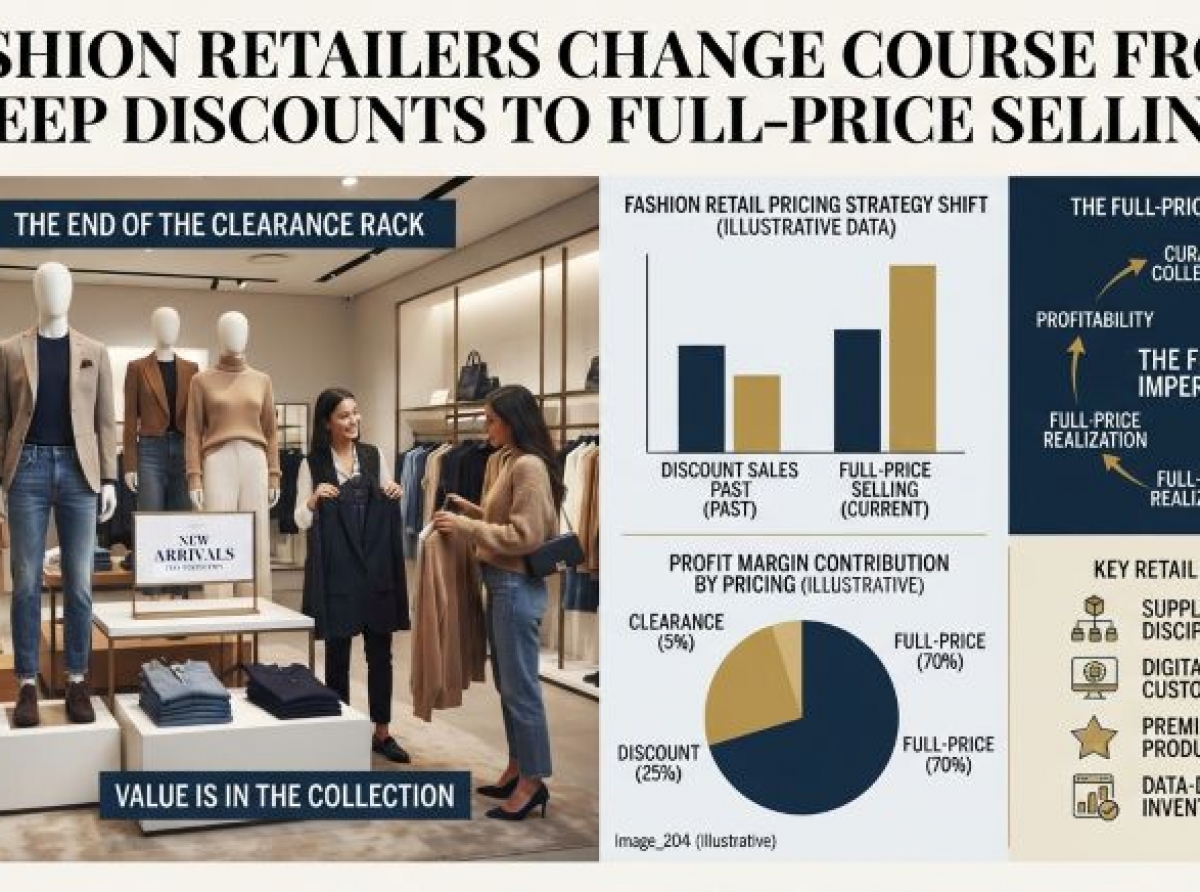
India’s fashion retailers are reassessing their dependence on promotional sales as many consumers delay purchases in anticipation of discounts. Nearly three months of overlapping sales, spanning festive campaigns, Diwali, Black Friday and year-end clearances, have made markdowns a regular feature of the shopping cycle.
Around 60 per cent of Indian online shoppers are willing to wait up to three months for discounts, while 28 per cent make purchases exclusively during sale periods. For retailers, this behaviour is affecting full-price sales, gross margins and inventory planning. Brands that generate 60-70 per cent of annual turnover during promotional periods also face greater pressure to sustain profitability outside sale windows.
Festive discounts rise as apparel loses share
Data from unified commerce platform Fynd, based on over 65 brands across eight major marketplaces, including Myntra, Flipkart, Amazon, AJIO, Nykaa and Tata CLiQ, shows that average festive discounts increased to 46 per cent in September-October 2026 from 34 per cent in 2025. Nearly half of online fashion orders were placed at discounts of 50 per cent or more, while 18 per cent required markdowns exceeding 70 per cent.
Table: Festive E-commerce performance comparison 2025 vs. 2026
|
Festive E-commerce |
2025 in % |
2026 in % |
Commercial impact |
|
Average marketplace discount |
34 |
46 |
1,200 bps increase |
|
Clothing share of orders |
48 |
34.50 |
1,350 bps decline |
|
Footwear share of orders |
33 |
52.70 |
Overtook clothing |
|
Myntra and Flipkart order share |
89 |
76.80 |
AJIO and JioMart gained share |
|
Prepaid digital payments |
53 |
56.50 |
Lower COD-related return exposure |
Despite higher discounts, apparel lost share in the festive shopping basket. Clothing's contribution to online orders declined from 48 per cent to 34.5 per cent, while ethnic wear fell from 14 per cent to 4 per cent. Footwear gained ground, accounting for 52.7 per cent of orders and 58.4 per cent of sales value. Nearly 50.1 per cent of festive fashion orders were priced below Rs 1,000, indicating continued pressure on household spending.
"Consumers navigated a festive season marked by higher borrowing costs, elevated fuel prices, geopolitical uncertainties, and continued pressure on household budgets, making deliberate value the defining theme," explains Ragini Varma, Chief Business Officer, India, Fynd.
Retailers tighten inventory to protect margins
Offline retailers are moving away from early markdowns to protect full-price sales. So far apparel chains have resorted to mid-season discounts to clear inventory when footfall weakens. This has also trained customers to postpone purchases until clearance periods. However, retailers are now focusing on tighter inventory planning, better product selection and premium brand contributions to reduce dependence on promotions.
Shoppers Stop's Q2 FY27 performance is an example of this approach. The department store operator returned to consolidated net profitability, reporting a profit after tax of Rs 3 crore against a loss of Rs 20 crore in the year-ago period. Pre-Ind AS EBITDA increased 56 per cent to Rs 43 crore.
The company reduced private-label inventory by 26 per cent year-on-year, increased premium brands' contribution to 73 per cent of department store sales and raised average transaction value by 9 per cent to Rs5 ,471.
"We are building on a nicer product, which is not necessarily a price hike, but a better product and testing out prices of Rs 1,299 and Rs1,499, and we are seeing very, very good success there," says Kavindra Mishra, Managing Director and CEO, Shoppers Stop, during the Q2 FY27 earnings call.
Lifestyle International has also prioritised full-price selling by limiting discounts on fresh merchandise and aligning inventory with seasonal demand. The company reported FY25 operating revenue of Rs 11,766 crore and profit after tax of Rs 415 crore, up 42.1 per cent.
Omnichannel pricing becomes critical
The growing overlap between online and offline shopping is making inconsistent pricing difficult to sustain. Consumers tend to compare marketplace prices with those offered at physical stores. A substantial discount on an online platform can undermine the economics of a store selling the same product at full price. Retailers are responding through unified pricing, integrated inventory and store-linked fulfilment.
Buy Online, Pick Up In Store (BOPIS) and Buy Online, Return In Store (BORIS) models are helping retailers use physical outlets as fulfilment and return centres. These services also create opportunities for additional purchases during store visits.
The challenge is particularly more in apparel, where online returns averaged 14.9 per cent, compared with 10.5 per cent for footwear. For orders above Rs 10,000, apparel returns reached 15.2 per cent, alongside an 11.7 per cent return-to-origin rate. Unified order management also allows brands to reserve new collections for their own websites and flagship stores while restricting deep markdowns to ageing inventory.
Brands shift to price discipline
The move away from discount-led growth is visible across different apparel price segments. Arvind Fashions reported a 136-basis-point expansion in gross margins and a 29.6 per cent increase in profit after tax in Q2 FY27. The company attributed the improvement partly to lower retail discounting and 7.3 per cent like-for-like retail growth, which increased to 10 per cent after adjusting for festive shifts.
Their strategy includes increasing direct-to-consumer sales through a network of 1,044 exclusive brand outlets and reducing dependence on third-party marketplace promotions.
At the value end, Trent's Zudio has adopted an everyday-low-price model instead of conventional promotional cycles. With merchandise largely priced below Rs999 and frequent inventory refreshes, the chain does not depend on traditional sale events. Zudio crossed 1,000 stores across more than 300 cities in September 2026. Trent's standalone revenue increased 18.5 per cent to Rs 5,666 crore in Q1 FY27, while operating EBITDA rose 36 per cent to Rs 847 crore.
Product differentiation replaces promotional dependence
Marketplace expansion continues to create opportunities for fashion brands, but higher discounts are not necessarily translating into stronger apparel demand.
AJIO increased its share of festive orders by 4.3 percentage points to 7.3 per cent, while Tier II markets increased their contribution from 19 per cent to 35 per cent. Eastern India accounted for 20.8 per cent of orders, indicating wider geographical demand. However, discount-led customer acquisition remains expensive. Brands are therefore looking to improve product differentiation, fabric quality, sizing consistency and design to justify full-price purchases.
Fynd's data shows that orders above Rs 3,000 accounted for just 11.8 per cent of festive order volumes but generated 40.9 per cent of total sales value. The overall average selling price stood at Rs 1,643.
This highlights an opportunity for retailers to improve revenue quality rather than depend entirely on transaction volumes. Discounts are likely to remain important for seasonal transitions and inventory liquidation, but using them as a regular acquisition strategy risks weakening pricing power.
For India's fashion retailers, the next phase of growth will depend on balancing marketplace visibility with inventory control, full-price sell-through and stronger direct consumer relationships.










 Get in Touch!

