
Global labels rework India strategy as shoppers trade up to premium category
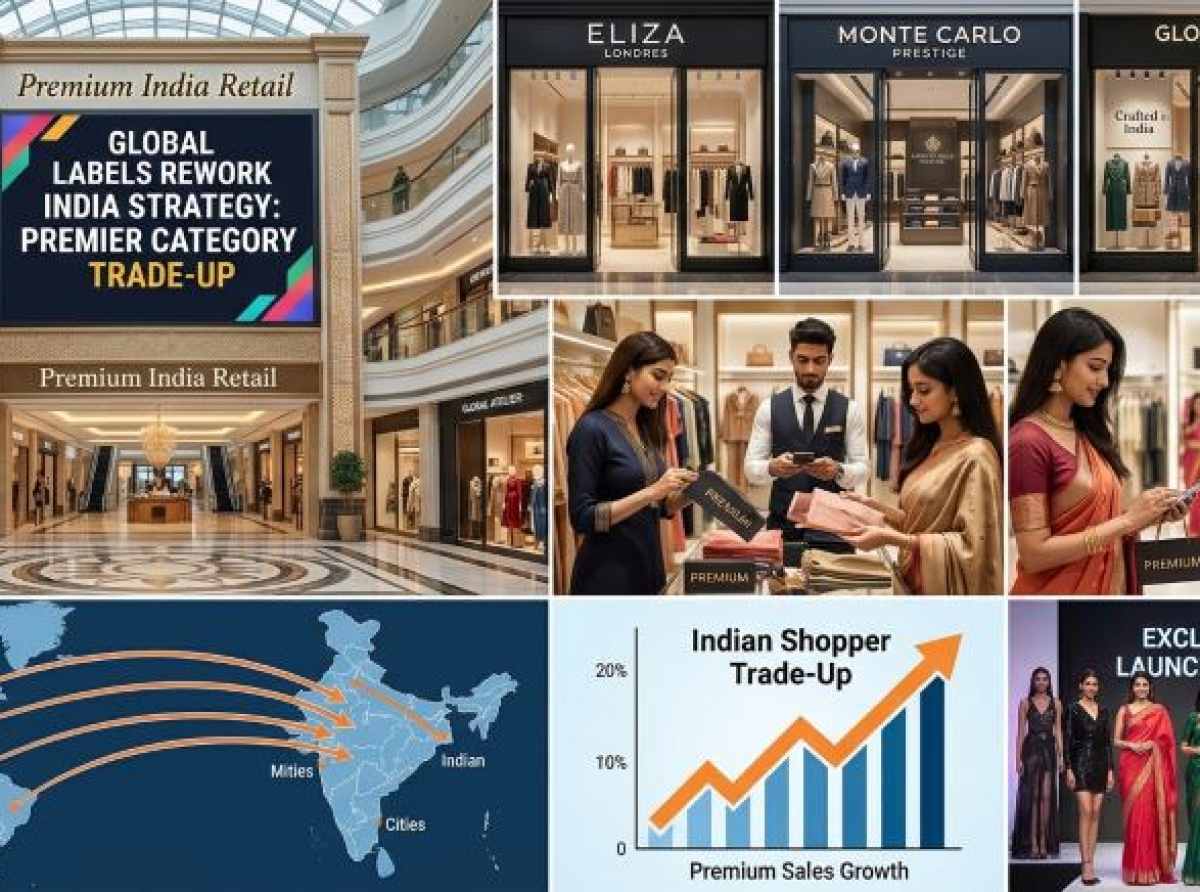
India’s apparel market is witnessing a shift towards premiumisation, with consumers prioritising fabric quality, fit, design and versatility over frequent, low-cost purchases. Global fashion brands are responding by positioning themselves around product value and design longevity rather than conventional fast-fashion cycles.
Daniel López García, Director of Expansion at Mango, has said the Barcelona-based fashion house does not view itself as a fast-fashion brand, but as an elevated, design-led label focused on durability and style. The positioning reflects a market where aspirational consumers are trading up. Studies point to strong growth in mid-premium and premium apparel, supported by rising discretionary incomes, urbanisation and digital access. For international labels, the opportunity lies in capturing higher-value purchases without competing solely on discounts.
Price segments diverge
India’s apparel market spans value-led mass retail to accessible luxury, with distinct consumer expectations and growth patterns across price points.
|
Retail segment |
Core price |
Projected growth (CAGR) |
Dominant consumer behavior |
Retail channels |
|
Mass Market |
Below Rs 1,500 |
8-10% |
Value-conscious, price-sensitive, high discount sensitivity |
High-street value chains, open marketplaces |
|
Mid-Premium |
Rs 1,500 -4,500 |
18-25% |
Aspirational trading-up, trend awareness, everyday workwear |
Departmental formats, brand digital apps, regional malls |
|
Premium / Accessible Luxury |
Rs 4,500- 12,000 |
35-45%+ |
Brand loyalty, fabric quality, capsule wardrobe investment |
Grade-A flagship malls, integrated omnichannel platforms |
|
Bridge-to-Luxury |
Above Rs 12,000 |
25-30% |
Exclusivity, occasion wear, global designer alignment |
Luxury shopping precincts, concierge e-boutiques |
Growth figures are indicative industry estimates and should be read in the context of differing market definitions.
The faster projected growth in premium categories is encouraging brands to sharpen product differentiation, curate collections and build stronger retail experiences. Consumers are increasingly expected to pay for perceived value, making fabric, construction and design consistency central to positioning.
Stores become fulfilment hubs
Physical stores are taking on a wider role as brands integrate offline retail with digital ordering, inventory management and fulfilment. Instead of maintaining separate stock pools for e-commerce and stores, retailers can use a unified inventory to route orders from the nearest outlet.
Myntra, which manages Mango’s master franchise and omnichannel presence in India, has integrated physical retail into its digital structure. Venu Nair, Myntra’s chief of strategic partnerships and omnichannel, has highlighted the importance of combining store networks with digital fulfilment to meet younger shoppers’ expectations of speed and availability.
Myntra’s network spans around 2,000 stores across retail partners. Such infrastructure can help brands reduce delivery times, improve stock utilisation and limit markdowns caused by inventory imbalances. It also gives international labels access to regional markets without requiring them to build an entirely independent distribution network.
Mango’s partnership model
Mango’s India expansion shows how global brands can combine international brand control with local operating capabilities. The label has grown to more than 80 points of sale, including over 40 exclusive brand outlets and shop-in-shop formats, across major markets such as Mumbai, Delhi-NCR, Bengaluru and Pune.
Under the partnership, Mango retains control over its global identity, design direction and collections, while Myntra supports local expansion, distribution, supply-chain operations and digital demand analysis. The arrangement offers a route to scale while limiting the operational burden of building a standalone local infrastructure. For the domestic platform, international labels also strengthen its premium portfolio and provide access to consumers seeking global fashion brands.
EASITEX
Speed without discounting
Younger shoppers expect faster access to seasonal collections, new launches and occasion-led purchases. This puts pressure on retailers to improve fulfilment while protecting premium positioning. For global brands, the challenge is to meet these expectations without relying on perpetual promotions. Localised inventory, curated product drops and integrated store networks can help bridge the gap between speed and brand value.
Quick-commerce-style expectations may influence fashion fulfilment, but apparel presents additional complexities, including size availability, fit-related returns and the need for product discovery. Brands must balance delivery speed with an experience that supports considered purchases.
Costs remain a constraint
Expansion is not without challenges. Import duties, prime retail rentals and e-commerce returns can weigh on margins, particularly for international brands operating across multiple channels. Maintaining consistent pricing and product availability across stores and online platforms also requires close inventory coordination.
The opportunity remains significant as organised retail expands and consumers move towards branded, higher-value products. However, premiumisation alone does not guarantee profits: brands must sustain full-price sales, manage operating costs and build repeat demand.










 Get in Touch!

