
Northeast fashion labels move from regional craft to mainland luxury retail
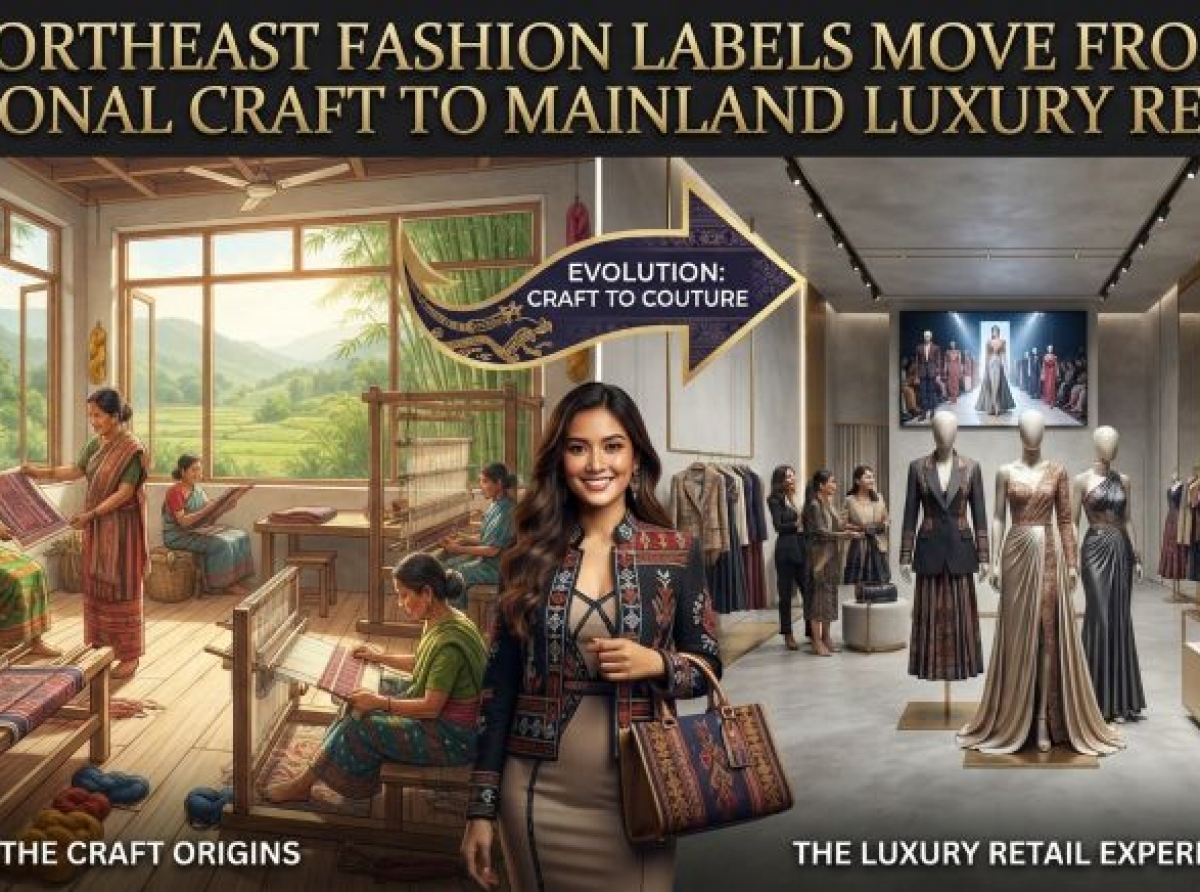
India’s Northeast is emerging as a distinct source of contemporary luxury fashion, with independent design houses moving beyond regional craft showcases to secure commercial space in mainland India’s premium retail market. Labels like Daniel Syiem’s Ethnic Fashion House, Jenjum Gadi, Kintem, Robert Naorem, Asa Kazingmei and established designer Atsu Sekhose are repositioning indigenous textiles through contemporary silhouettes, premium ready-to-wear and occasion wear. Their growing presence in multi-designer boutiques reflects a shift in how consumers and retailers value regional craftsmanship.
The commercial opportunity lies in converting indigenous textiles into differentiated luxury products. Rather than selling traditional garments as cultural artefacts, these designers are building brands around distinctive fabrics, weaving techniques and design identities that can compete in India's premium fashion market.
The shift also creates a new commercial pathway for artisan clusters in Nagaland, Meghalaya, Manipur, Arunachal Pradesh and Assam, connecting decentralised production with metropolitan consumers and international buyers.
Premium retail opens new markets
India’s apparel market is worth around $90 billion, and this has created opportunities for smaller design houses targeting consumers willing to pay for craftsmanship, limited production and material differentiation.
Multi-designer retailers such as Ogaan, Pernia’s Pop-Up Shop, Ensemble and Aza are offering access to affluent consumers through curated selections of independent labels. This distribution is helping Northeast designers move beyond regional exhibitions and local customer bases.
The design proposition has also evolved. Meghalaya’s Ryndia, an indigenous Eri silk, is being transformed into contemporary evening wear, tailored separates and bridal ensembles. Manipur’s Wangkhei Phee and Meitei silk are finding applications in minimalist occasion wear, while Naga handwoven textiles and tribal beadwork are being incorporated into experimental ready-to-wear.
For designers, the challenge is to make heritage commercially relevant without diluting its identity. Contemporary cuts, wearable proportions and consistent finishing are becoming as important as the provenance of the fabric. Daniel Syiem’s Ethnic Fashion House (DSEFH), established in Shillong in 2011, highlights this transition. The label works with Ryndia to develop ready-to-wear, executive tailoring and bridal collections. Its direct relationships with artisan communities across Meghalaya’s Ri-Bhoi district help maintain control over sourcing and production. The business reports annual sales growth of around 30%, indicating the potential of heritage-led premium positioning.
The regional design scenario
The emerging labels are building differentiated propositions around their respective textile traditions.
Table: Northeast India designer labels & textile craft
|
Design label |
Origin |
Core textile or craft |
Retail positioning |
|
Daniel Syiem’s EFH |
Meghalaya |
Ryndia (Eri silk) |
Global pop-ups and couture |
|
Jenjum Gadi |
Arunachal Pradesh |
Tribal beadwork and cotton |
Metro boutiques and prêt |
|
Kintem |
Nagaland |
Loin-loom Naga weaves |
D2C and contemporary prêt |
|
Robert Naorem |
Manipur |
Wangkhei Phee and Meitei silk |
Luxury bridal and occasion wear |
|
Asa Kazingmei |
Nagaland |
Naga handwoven textiles |
Avant-garde and high-street fashion |
The opportunity is not limited to fabric-led differentiation. These businesses are developing identifiable design languages that can support brand recognition, premium pricing and repeat purchases.
Supply constraints limit scale
Despite growing retail interest, production issues remain a major constraint. Traditional handloom production is labour-intensive and cannot match the speed or volumes of industrial textile manufacturing. Authentic loin-loom fabrics and extra-weft Wangkhei Phee can take several weeks to produce, restricting availability and making inventory planning difficult.
Small production batches of 10-20 units per style are common. This limits the ability to replenish popular products quickly and makes conventional wholesale distribution difficult. The supply chain is further complicated by the shortage of specialised garment manufacturing, dyeing and finishing facilities in the Northeast. Weaving may take place in villages across Ri-Bhoi or Mokokchung, while pattern development, grading, cutting and stitching are outsourced to workshops in Delhi, Noida or Kolkata. The result is higher logistics costs, longer production cycles and fragmented quality control.
Cost of regional manufacturing
The difference between decentralised handloom production and integrated mainland manufacturing is reflected in operating costs and inventory models.
Table: Northeast handloom vs. mainland hubs a supply chain comparison
|
Operations |
Northeast handloom clusters |
Mainland hubs |
|
Textile Lead Time |
6-10 weeks |
1-2 weeks |
|
Freight Cost |
18-25% additional premium |
Domestic baseline |
|
Industrial Finishing |
Limited and fragmented |
Integrated facilities |
|
Inventory Model |
Pre-orders and capsule drops |
Continuous stock rotation |
|
Average Order Value |
Rs 14,000-38,000 |
Rs 3,500-9,000 |
Source: Textile Trade Promotion Council and logistics industry benchmarks
These constraints make scale through conventional retail channels commercially challenging. Higher production costs also leave brands with limited room to absorb discounts, returns and unsold inventory.
For premium labels, the answer increasingly lies in controlling volumes rather than pursuing mass distribution.
D2C and private clients drive growth
Design houses are adapting their business models to accommodate production realities. Pre-order collections, limited-edition digital launches, private client appointments and trunk shows are emerging as more viable routes to market. Direct partnerships with weavers also offer greater visibility over sourcing and production. In some cases, advance payments help artisan groups secure working capital, reducing the financial pressure associated with long production cycles. This approach allows designers to align demand with available production capacity while maintaining exclusivity and protecting margins.
Global demand is another growth avenue. European and North American specialty retailers are showing interest in traceable natural fibres, traditional weaving and low-volume artisanal products. Eri silk and naturally dyed textiles offer Northeast labels a differentiated proposition in these markets, particularly as sourcing transparency gains importance in premium fashion. However, expansion beyond India will require reliable quality standards, documentation, consistent delivery schedules and stronger distribution partnerships.
Infrastructure to determine next phase
The long-term opportunity depends on whether the region can develop manufacturing infrastructure around its existing artisan base. Investments in regional connectivity and proposed mini-textile parks across Assam, Nagaland and Meghalaya could help bring processing and finishing capabilities closer to weaving clusters. Access to specialised equipment, skilled garment workers and common production facilities would reduce dependence on mainland workshops.
For the industry, the objective should not be to replicate large-scale power-loom manufacturing. It should be to create a decentralised premium textile ecosystem that combines traditional production with modern design, finishing and commercial management.
Northeast design houses have shown that indigenous textiles can move beyond cultural merchandising to become commercially viable luxury products. Their next challenge is to build businesses that can sustain premium pricing, protect artisan livelihoods and meet the operational expectations of organised retail. The region's competitive advantage lies in its craftsmanship and material identity. Converting that advantage into a scalable luxury business will depend on stronger supply chains, capital access and consistent retail execution.










 Get in Touch!

