
India's fashion market splits between deep value and premium aspirations
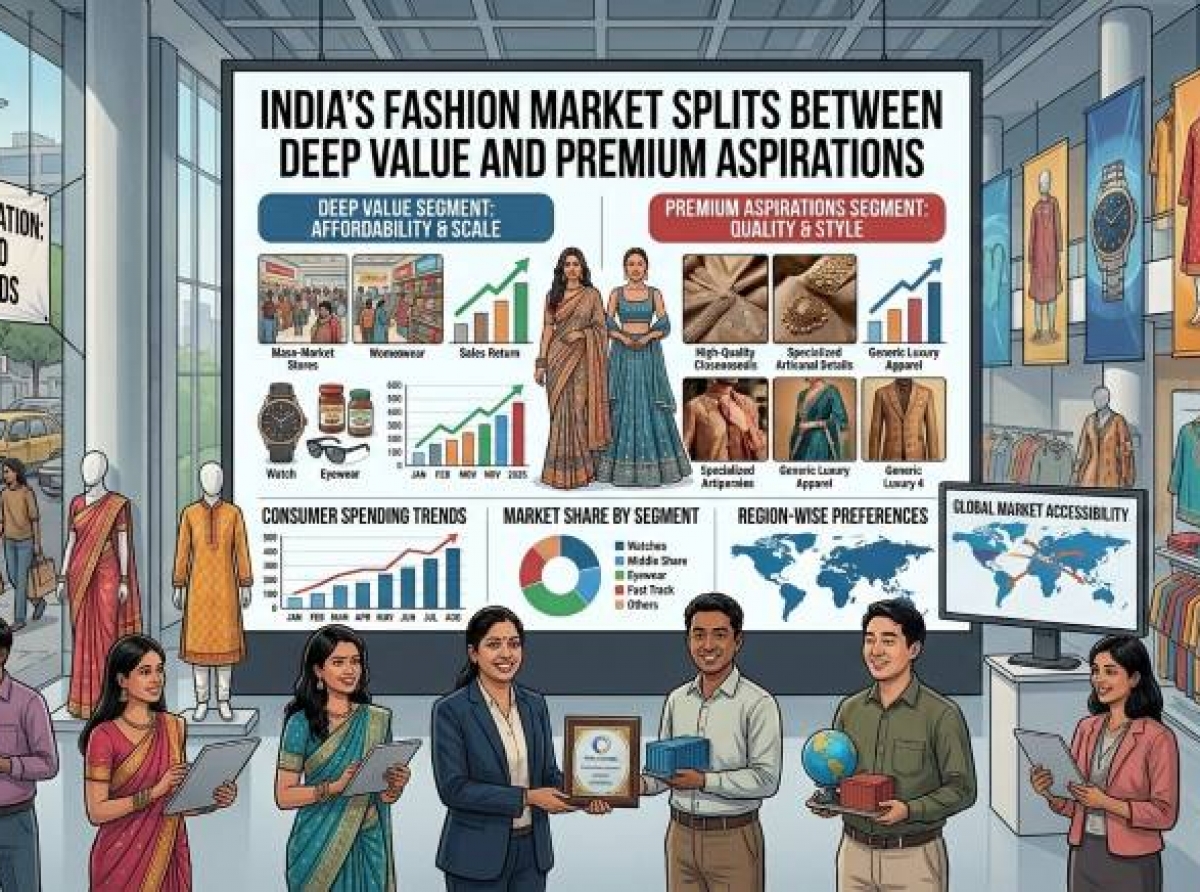
India’s organised fashion retail market is entering a new phase of premiumisation, challenging the long-standing assumption that low prices, rapid trend cycles and expanding store networks are sufficient to drive growth. Urban consumers are becoming more selective, placing greater value on fabric quality, fit, design differentiation and brand identity.
The shift is exposing a growing gap between retailers dependent on volume and discounting and those able to command stronger price realisations through differentiated merchandise. The contrasting performance of global fashion retailers highlights this transition. Swedish retailer H&M has faced margin pressure and greater dependence on markdowns to clear inventory, while Inditex-owned Zara has maintained stronger price realisation despite moderating revenue growth.
Inditex Trent Retail India Private Ltd (ITRIPL), the joint venture between Inditex and Tata Group's Trent, reported a 23 per cent increase in FY25 net profit to Rs 299.84 crore on revenues of Rs 2,782.06 crore. Its premium brand Massimo Dutti recorded nearly 28 per cent revenue growth to Rs 128.45 crore during the same period. The numbers underline the commercial appeal of elevated fashion positioning, even as the broader market becomes more competitive.
The value divide
India's fashion market is splitting into two distinct consumer propositions: affordable everyday essentials and aspirational, design-led apparel. The middle ground, where brands offer neither compelling prices nor meaningful product differentiation, is facing mounting pressure. The distinction between value-first and aspirational fashion retail is becoming more pronounced.
|
Parameter |
Value-first fashion: H&M model |
Aspirational fashion: Zara model |
Emerging homegrown premium |
|
Core proposition |
Entry prices, trend volume and rapid churn |
Design distinction and brand appeal |
Craftsmanship, natural fabrics and tailored fits |
|
Markdown exposure |
Higher dependence on seasonal discounts |
More controlled discounting |
Limited markdowns through smaller production runs |
|
Material mix |
Higher synthetic and poly-blend exposure |
Natural fibre blends and structured textiles |
Linen, combed cotton and handloom blends |
|
Sourcing |
Centralised, high-volume procurement |
Flexible, responsive vendor networks |
Domestic textile clusters and specialised weavers |
|
Financial focus |
Store expansion and sales volumes |
Full-price sell-through and margins |
Average transaction value and repeat purchases |
Premiumisation, however, is no longer defined simply by expensive labels or imported merchandise. Consumers increasingly associate premium value with better construction, natural fibres, understated branding, distinctive silhouettes and limited-edition collections.
This is changing store economics as well. Retailers are placing greater emphasis on average transaction values, product presentation and curated assortments rather than relying exclusively on footfall and promotional activity.
Retail sector analyst Radhika Sen of Capital Markets Advisory opines, "The urban Indian consumer is experiencing fast-fashion fatigue." Shoppers are evaluating the durability and quality of garments against their purchase price rather than simply counting the number of items they can buy.
Quality reaches the factory
The shift towards differentiated merchandise is changing sourcing priorities across India's textile and garment manufacturing ecosystem. Retailers are seeking greater access to premium cotton blends, linen, structured fabrics and specialised finishes. Manufacturing clusters such as Tirupur, Surat, Jaipur and Bengaluru are positioned to benefit from demand for enzyme washes, surface detailing and higher-value fabrications.
For Indian manufacturers, this is an opportunity to move beyond low-margin garment assembly and compete on product development, material quality and specialised manufacturing capabilities. Domestic brands are also integrating regional textile craftsmanship into contemporary Western silhouettes. Partnerships with specialised weavers and smaller production units allow them to introduce distinctive collections without depending entirely on large, centralised sourcing networks.
The PM MITRA textile parks initiative could further support this transition by strengthening integrated spinning, weaving, processing and garment manufacturing infrastructure. The competitive advantage will lie in the ability to deliver smaller production batches, maintain consistent quality and respond quickly to changing consumer preferences. Better inventory control can also reduce excess stock and protect full-price sales.
Homegrown brands find space
The changing market creates an opportunity for domestic retailers, including Reliance Retail, Aditya Birla Fashion and Retail (ABFRL) and Trent, to strengthen their premium and private-label portfolios.
Traditional department store formats built around undifferentiated mid-market brands are under pressure. Retailers need sharper positioning to justify their prices and retain customer loyalty. Trent is an interesting example of how the market is fragmenting. Through Zudio, it addresses the aggressive value-fashion segment, while its Inditex partnership gives it access to aspirational urban consumers through Zara and Massimo Dutti.
Homegrown brands are also capitalising on the shift. Fabindia, Anita Dongre's AND and Global Desi, and D2C label Rare Rabbit have built propositions around differentiated design, structured silhouettes, premium fabric choices and occasion-led merchandise.
Consumers are willing to pay more when the product delivers visible improvements in fabric, fit and finish. This creates room for brands to command premiums over conventional fast-fashion price points without entering the luxury segment. The opportunity is particularly relevant as premium consumption expands beyond the largest metropolitan markets into emerging urban centres.
The new retail equation
The next phase of Indian fashion retail will be determined less by the number of stores a brand operates and more by the quality of its merchandise, inventory discipline and ability to sustain pricing power.
Retailers dependent on high-volume procurement and recurring markdowns risk losing both margins and brand relevance. Those investing in differentiated products, responsive sourcing and controlled assortments are better positioned to capture aspirational spending.
For India's textile and apparel industry, this also signals a shift in the value chain. The opportunity is moving beyond manufacturing more garments towards producing better fabrics, sharper designs and higher-value products. Premiumisation is not eliminating value fashion. It is making the middle of the market more competitive. The winners will be retailers that can offer either compelling affordability or a convincing reason to pay more.










 Get in Touch!

