
KVIC Chief targets fashion industry's 'Export-Only' sustainability double standards
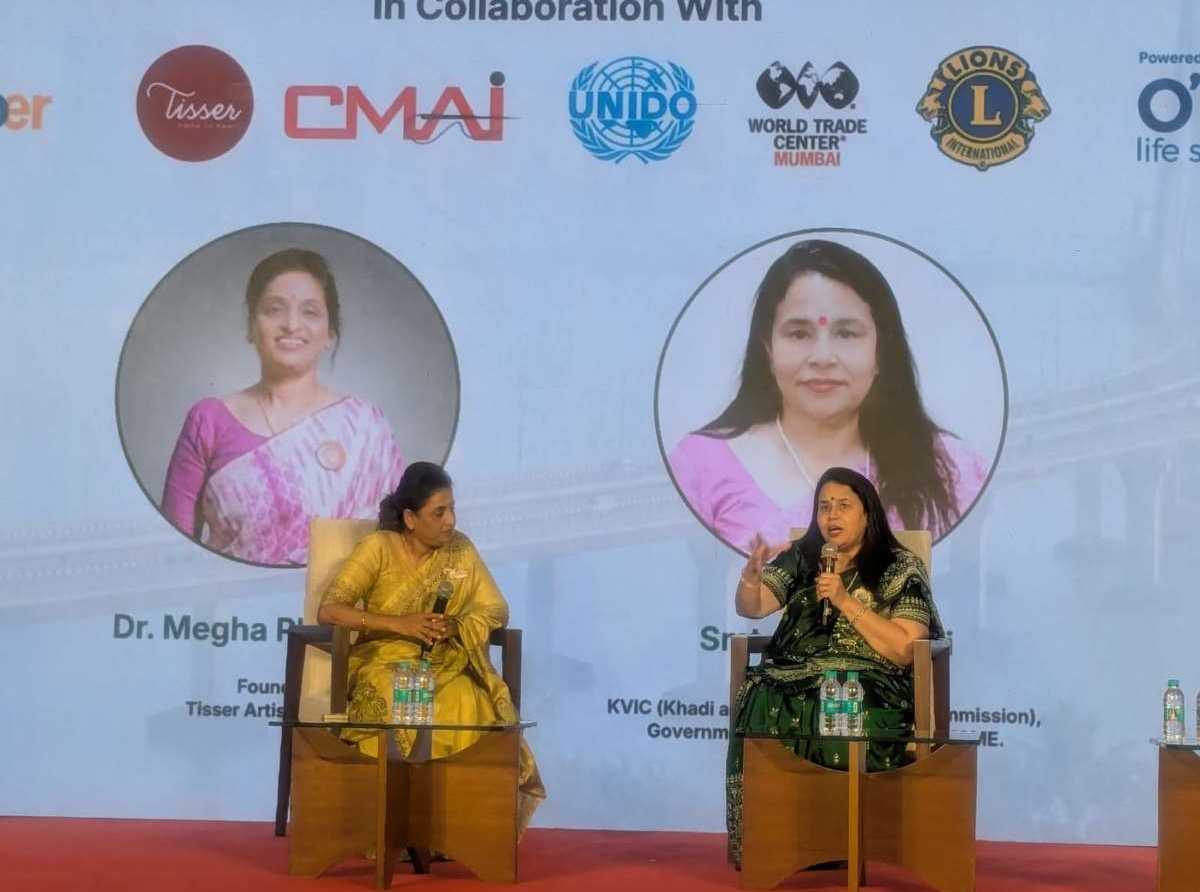
India’s fashion industry is operating under a glaring ethical split: cleaning up its environmental act for Western buyers while dumping irresponsible, opaque products on the domestic market.
Speaking at a fireside chat during 'Mumbai's Mega Post-Consumer Waste Collection & Upcycling Initiative' on World Environment Day (June 5), Roop Rashi, CEO of the Khadi and Village Industries Corporation (KVIC), called out this "export-only" approach to sustainability, demanding that Indian industrial leaders implement the same rigorous standards at home that they do abroad.
"Today, India is at a peculiar cusp," noted Rashi, who previously served as the nation's Textile Commissioner. "When regulations come in Europe, our people start doing sustainability, responsibly. We do it responsibly for the rest of the world, but we don't do it for ourselves. Industrial leaders have to make a conscious decision... to produce less, but more responsible products for my consumer domestically also, not only for the labels outside."
Confronting India's 8% waste crisis
The scale of the challenge is massive. India currently generates 8% of the world’s textile waste. Yet, Roop Rashi rejected the corporate narrative that the crisis can only be solved by halting production or relying on mega-scale, centralized recycling factories. Instead, she argued that textiles must be reframed as a perpetual resource rather than "waste," and managed through extreme localization.
"Textile is not waste till it cannot be recycled into any other product," Rashi asserted.
To bridge the gap between waste generation and conscious domestic consumption, Roop Rashi called for absolute traceability. She urged manufacturers to clearly disclose resource footprints…such as water and energy consumption, giving domestic buyers an informed choice at the cash register.
Erasing the "Charity" mindset
A primary reason sustainable and traditional textiles struggle to compete domestically is how they are marketed. For decades, supporting local weavers has been framed as an act of philanthropy. Rashi argued that this patronizing attitude actively harms the industry.
"We should not think that when we are talking to an artisan that he is a bechara (helpless) artisan," Rashi said. "He actually possesses some special skill... It is not an artisan; it is an artist. Till we bring it to that higher plane, we will never follow it."
Demystifying the "magic" of spinning lower-length waste fibers into high-value fabrics is central to capturing younger consumers. Rashi highlighted a sharp behavioral shift over the last five years: the younger generation is actively willing to pay a premium for recycled apparel, but only if the product is genuinely traceable and fashionable. "If sustainability doesn't become fashionable, people will not put their money there," she added.
The "Lijjat Papad" blueprint for circularity
Rejecting the idea that circular fashion requires massive industrial centralization, Rashi pointed to deep-rooted Indian business models as the true roadmap.
She cited the iconic Shri Mahila Griha Udyog Lijjat Papad—which employs over 43,000 women across India through a highly distributed, decentralized network—as a benchmark for textile recycling. "Why can't we do that in a distributed way?" she asked, arguing that each city should independently manage its own textile resources.
To make this a reality, Rashi offered the full backing of the Ministry of Micro, Small and Medium Enterprises (MSME) and KVIC’s regional resources in Mumbai. Government schemes are available to hand-hold decentralized enterprises, offering training, traceability metrics, and the marketing infrastructure needed to scale upcycled products.
Culture as a shield against fast fashion
The discussion, chaired by Dr. Megha Phansalkar, Founder of social enterprise Tisser, also touched upon institutional interventions. Dr. Phansalkar shared how Bhutan effectively curbed fast fashion by legally mandating that citizens wear locally-woven traditional dress in public and government spaces.
While Rashi acknowledged that Prime Minister Narendra Modi has consistently urged citizens to adopt Khadi and handloom, institutional adoption in India remains restricted to a few ministries. While she avoided pitting traditional clothing against modern apparel; noting that modern fast fashion still drives massive agricultural and rural employment, she stressed that localizing production is the only viable path to achieving India's sustainability goals.
"If we do not localize, if we do not increase the potential from the local industry, sustainability will not come," Rashi concluded. "We must imbibe a pride in local manufacturing with less energy and less resource use. There should be pride in this value."











 Get in Touch!
