
The Rs 600 cr test, has Indian luxury earned global maison status?
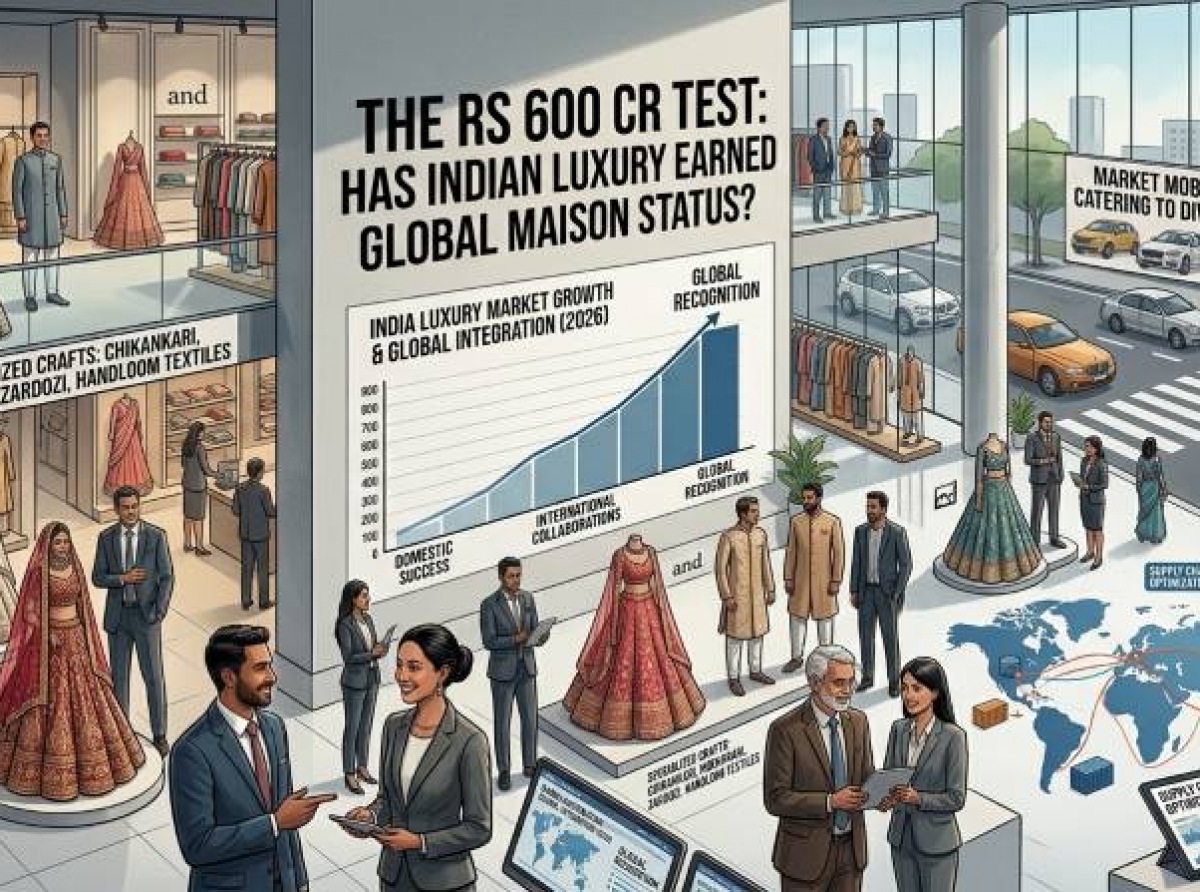
India’s luxury fashion market has seen a shift in commercial power. Domestic couture houses are recording revenues that rival, and in some cases exceed, those of established European luxury brands operating in the country. Yet higher turnover raises a fundamental question: have Indian designers built enduring luxury maisons, or are they still heavily dependent on the economics of weddings and occasion wear?
The revenue shift
Financial data indicate a changing competition. For example, Sabyasachi Calcutta LLP, under Aditya Birla Fashion and Retail Ltd (ABFRL), saw its revenue increase from Rs 487.3 crore in FY25 to Rs 645.4 crore in FY26. Manish Malhotra recorded Rs308.3 crore in FY25, a 34.6 per cent growth over the previous year. Tarun Tahiliani also grew at 11.2 per cent to Rs 205.8 crore.
The performance contrasts with several European luxury labels. Louis Vuitton India reported FY25 revenue of Rs 802.5 crore, down 1.7 per cent. Gucci India declined 17.3 per cent to Rs 265.4 crore, while Christian Dior India fell 3.2 per cent to Rs 257 crore. Hermès India was an exception, growing 35.4 per cent to Rs 427.9 crore.
Table: Luxury & couture fashion brands growth (FY24-FY26)
|
Brand |
Segment |
FY24 Revenue (Rs cr) |
FY25 Revenue (Rs cr) |
FY26 Revenue (Rs cr) |
FY25 Growth |
|
Louis Vuitton India |
European luxury |
816.2 |
802.5 |
Pending |
-1.70% |
|
Sabyasachi |
Indian couture |
487.3 |
487.3 |
645.4 |
Flat |
|
Hermès India |
Ultra-luxury |
322.2 |
427.9 |
Projected strong |
+35.4% |
|
Manish Malhotra |
Couture and bridal |
229 |
308.3 |
Pending |
+34.6% |
|
Gucci India |
European luxury |
320.9 |
265.4 |
Pending |
-17.30% |
|
Christian Dior India |
European luxury |
265.5 |
257 |
Pending |
-3.20% |
|
Tarun Tahiliani |
Couture and prêt |
185 |
205.8 |
Pending |
+11.2% |
Source: MCA filings, company disclosures and industry research. FY26 figures are included where available.
The numbers establish the growing scale of Indian designer businesses. However, revenue comparisons need qualification: the brands operate across different categories, price points and business models. Turnover alone cannot establish equivalent brand equity.
Business beyond weddings
Luxury is built on pricing power, scarcity, craftsmanship and the ability to command premium prices across categories. A business dependent primarily on high-value bridal orders may generate substantial revenue without developing the broader consumption patterns associated with established global maisons. "Turnover is an accounting output, not a measure of brand equity," says Radha Nair, Senior Retail and Brand Strategist at Verve Capital Advisory.
She points to the distinction between wedding expenditure and everyday luxury purchases. A customer willing to spend Rs 15 lakh on a bridal ensemble may not necessarily spend Rs 1.5 lakh on an Indian designer's daywear, business suit or leather accessory. This exposes the biggest challenge for Indian luxury: converting occasion-led purchasing into year-round brand consumption.
India's personal luxury market is growing but spending remains uneven. Ultra-high-net-worth consumers continue to purchase investment-grade handbags, jewellery and bespoke couture, while aspirational customers have become more cautious about discretionary European fashion purchases.
Global groups such as LVMH and Kering benefit from diversified portfolios spanning leather goods, watches, eyewear, fragrance and apparel. These categories generate recurring demand beyond ceremonial occasions. Indian couture, meanwhile, remains labour-intensive. Bespoke garments require extensive artisan hours, specialised skills and significant working capital, limiting scalability.
Building daily luxury
Indian designers are responding by expanding beyond bridal and occasion wear. Sabyasachi has diversified into fine jewellery, eyewear through Marcolin, beauty through its association with Estée Lauder, and leather accessories. Its fine jewellery business has reportedly crossed Rs 100 crore in revenue run-rate, providing a recurring commercial opportunity beyond seasonal wedding purchases.
International expansion is another part of this strategy. The Manhattan flagship near Fifth Avenue and the brand's showcase at Bergdorf Goodman demonstrate the potential for Indian craftsmanship to attract international luxury consumers. The latter reportedly generated more than $1 million in sales in a single day. The objective is to establish Indian design as a broader luxury proposition rather than a category restricted to weddings, traditional clothing and diaspora consumption.
Corporate capital changes the game
Institutional investment is boosting this shift. ABFRL acquired a 51 per cent stake in Sabyasachi for Rs 398 crore in 2021. It has also invested in designers including Tarun Tahiliani and Shantnu & Nikhil. Reliance Brands similarly acquired a 51 per cent stake in Manish Malhotra.
These partnerships bring capital, professional management, supply-chain systems and access to premium retail locations. They also provide the infrastructure needed to expand distribution, strengthen merchandising and establish international operations. The emergence of designer brands at destinations such as Mumbai's Jio World Plaza reflects this shift from independent couture businesses towards professionally managed luxury enterprises.
The global test
Sabyasachi's growth shows the possibilities of this model. Founded in Kolkata in 1999, the label built its identity around Indian textiles, handlooms, craftsmanship and bridal couture. Corporate investment has enabled it to extend that positioning into jewellery, accessories, beauty and international retail.
However, expansion brings its own challenges. India continues to face a shortage of dedicated luxury retail space beyond Mumbai and Delhi. Import duties on specialised materials and hardware add to operating costs, while scaling artisan-led production without compromising craftsmanship remains difficult.
Digital commerce is also changing the geography of demand. Luxury platforms reportedly receive more than half their transactions from non-metro pin codes, requiring brands to balance digital distribution with personalised boutique experiences.
Indian consumers are evaluating luxury through construction quality, material sourcing, finishing and service rather than labels alone. The Rs 600-crore revenue milestone is therefore an important commercial achievement, but not the final measure of luxury status. Indian designers have shown that domestic brands can command substantial spending and compete with European labels in their home market.
The next challenge is to establish recurring demand across everyday luxury categories, sustain international pricing power and attract consumers beyond the Indian wedding economy. The ultimate test will be whether a brand created in Kolkata or Delhi can command the same uncompromising global demand in Paris, London, New York and Tokyo. That is when Indian luxury will move from commercial success at home to genuine international maison status.











 Get in Touch!

